
eLearning Video Production Cincinnati: What Actually Works
eLearning Video Production: What It Takes to Get It Right
Most organizations producing eLearning content already know what they want to teach. The gap is almost never the subject matter — it's the production. Bad audio, shaky framing, or modules that drag past the 20-minute mark can tank completion rates for content that cost real money to develop. Getting eLearning video production right means solving the production problem, not just the content problem.
This guide breaks down what professional eLearning video production actually involves, what separates effective training videos from forgettable ones, and how Cincinnati organizations are producing course libraries in a fraction of the time.
eLearning video production is the end-to-end process of creating video-based training content — from scripting and recording through editing and delivery. When the production environment matches the quality of the content, completion rates go up and the content earns a longer shelf life.
Quick Answer
eLearning video production is the process of planning, recording, and editing video-based training content for online delivery. Done well, it combines professional audio and video with strong instructional structure. The result is training that employees actually complete — and retain. For most organizations, the biggest gap is production environment: great content paired with poor audio or shaky framing signals low credibility and drives dropoff.
What eLearning Video Production Actually Involves
eLearning video production covers four distinct stages. Most organizations underinvest in the first and last while putting all their energy into the middle two.
Pre-Production
This is where most projects succeed or fail before the camera ever turns on. Pre-production includes scripting (or building a strong talk-track outline), module structure decisions, and instructional design choices: What does a learner need to be able to do at the end of this module? How long should it be? How does it connect to the module before and after?
A common mistake is treating pre-production as optional. Teams arrive at a recording session with a rough idea of what they want to cover and end up recording three times as much footage as they'll use — most of it unusable.
Recording
The recording environment determines the ceiling on your final product. Camera framing, lighting, and — most critically — audio all need to be dialed in before you start. The course creation services at a professional studio handle all of this so your subject-matter expert can focus on delivery, not gear.
For multi-module courses, batch recording is the most efficient model: plan all modules in advance, book a full recording day, and capture an entire course library in one or two sessions. This also creates visual consistency across the course — same setup, same background, same audio profile.
Post-Production
Editing removes dead air, tightens transitions between points, and adds any supporting graphics or captions. Most LMS platforms require specific file formats and encoding settings. Getting the handoff right here saves headaches at upload time. If the course includes any supporting materials — assessments, PDFs, supplemental reading — those get packaged at this stage too.
Repurposing
One recording session can produce more than just the course modules. Short clips from training content perform well for internal communications, social media, and promotional content that drives enrollment. Short-form video clips pulled from a course recording can position your organization as a thought leader while also promoting the full course to new audiences.
The Elements That Make eLearning Videos Work
There's a consistent pattern across training videos that get completed versus ones that don't. Five elements show up every time.
Clear Learning Objective per Module
Tell the viewer what they'll be able to do at the end of this module — in the first 30 seconds. Not "in this module, we'll cover X" but "by the end of this, you'll know how to do Y." That framing keeps viewers engaged because they know where they're headed.
Professional Audio
This is the most important technical element, by a wide margin. Learners tolerate imperfect video far better than they tolerate background noise, room echo, or inconsistent volume. Research from the eLearning Industry consistently shows audio quality as the leading driver of early dropoff. A professional studio eliminates this variable entirely — treated acoustics, dedicated microphones per presenter, and monitored levels throughout the session.
Clean, Distraction-Free Visuals
The background should serve the content, not compete with it. A cluttered or unprofessional background is a credibility signal — and not a good one. For organizations where brand perception matters (consultants, associations, professional services firms), the visual environment is part of the message.
Focused Module Length
The research-backed sweet spot for eLearning module length is 8-12 minutes. Longer modules are fine for dense technical content, but they need clear chapter markers so learners can navigate. Shorter is better for compliance training, onboarding sequences, and anything with a discrete skill outcome. The professional webinar production model — structured, time-bounded, with a defined outcome — is a useful mental model for eLearning modules too.
Strong Opening
The first 30 seconds determine whether someone stays or clicks away. Lead with what they'll gain, not with credentials or a company overview. Hook first, context second.
Common eLearning Production Mistakes (and How to Avoid Them)
Even well-resourced organizations make the same production mistakes. These are the most common — and the most preventable.
Recording in the Wrong Environment
Conference rooms, home offices, and open offices all introduce the same problems: HVAC noise, room reverb, and unpredictable interruptions. These are manageable for a one-off recording but they compound over a multi-module course. Inconsistent audio across modules breaks the sense of professionalism and tells learners — consciously or not — that the content wasn't taken seriously.
The fix is straightforward: record in an acoustically treated space. For organizations producing training content that will live in an LMS for two or more years, booking a studio rental for a batch recording day is often the most cost-effective path.
Modules That Overstay Their Welcome
The instinct to be thorough — to cover every edge case, every qualifier, every nuance — is understandable. It's also the fastest way to kill completion rates. Effective eLearning modules are ruthlessly focused on the outcome. Everything that doesn't serve the stated learning objective belongs in a different module or in supplemental materials.
Reading a Script Word-for-Word
Scripted delivery sounds scripted. Learners disengage. The most effective presenters work from a detailed outline — key points, supporting examples, transitions — and deliver conversationally. If a presenter genuinely needs a script for complex technical content, a teleprompter is better than a read-off-the-page delivery.
Skipping the Production Day Plan
Arriving at a recording session without a module-by-module run-of-show costs time and money. The best sessions are built around a tight plan: which modules record in which order, transition language between modules, how long each module should run, and any visual aids or on-screen content that need to be ready. The Cincinnati Podcast Studio consulting team can help map this out before your recording day if you're starting from scratch.
When a Professional Studio Makes the Difference
Not every eLearning project needs a professional studio. A screen-recorded software tutorial, a quick HR update, or a one-time training module might be fine recorded on a webcam. But there are clear situations where the production environment pays for itself.
Content With a Long Shelf Life
If the course will live in your LMS for two or more years, the production quality needs to match that lifespan. Recordings that look and sound dated undermine the credibility of the content — even when the information is still accurate. Video podcasting services and course production share the same principle: content that represents your organization publicly should look the part.
Brand-Sensitive Content
Training content for clients, prospects, certification programs, or paid courses carries brand weight. The production environment is part of what communicates that your organization takes this seriously. For consultants, coaches, professional associations, and B2B organizations, a professional studio is a worthwhile investment in how the content reflects on the brand.
Multi-Module Batch Recording
The economics of batch recording make professional studio time a clear win for larger projects. Instead of setting up and tearing down a DIY recording space for each module, a single well-planned studio day can capture 8-12 modules with consistent quality across all of them. That's a complete course library from one session. Podcast idea research and course structure planning go hand-in-hand for organizations using a video-first content model.
When the Presenter Needs to Focus on Delivery
Subject-matter experts are not always comfortable on camera. When they're also managing their own equipment, lighting, and audio setup, delivery suffers. Removing the technical burden — and having a production team monitoring everything in real time — lets the presenter focus entirely on the content. The difference in delivery quality is significant.
How Cincinnati Organizations Produce eLearning Content at CPS
For Cincinnati and Greater Cincinnati/NKY organizations producing eLearning content, Cincinnati Podcast Studio offers a complete production model that removes the logistical friction of building a course library.
The process starts with a Discovery Call to map out the project: how many modules, target audience, technical requirements, and what a successful recording day looks like. That session produces a module-by-module plan so the recording day is structured and efficient from the first module to the last.
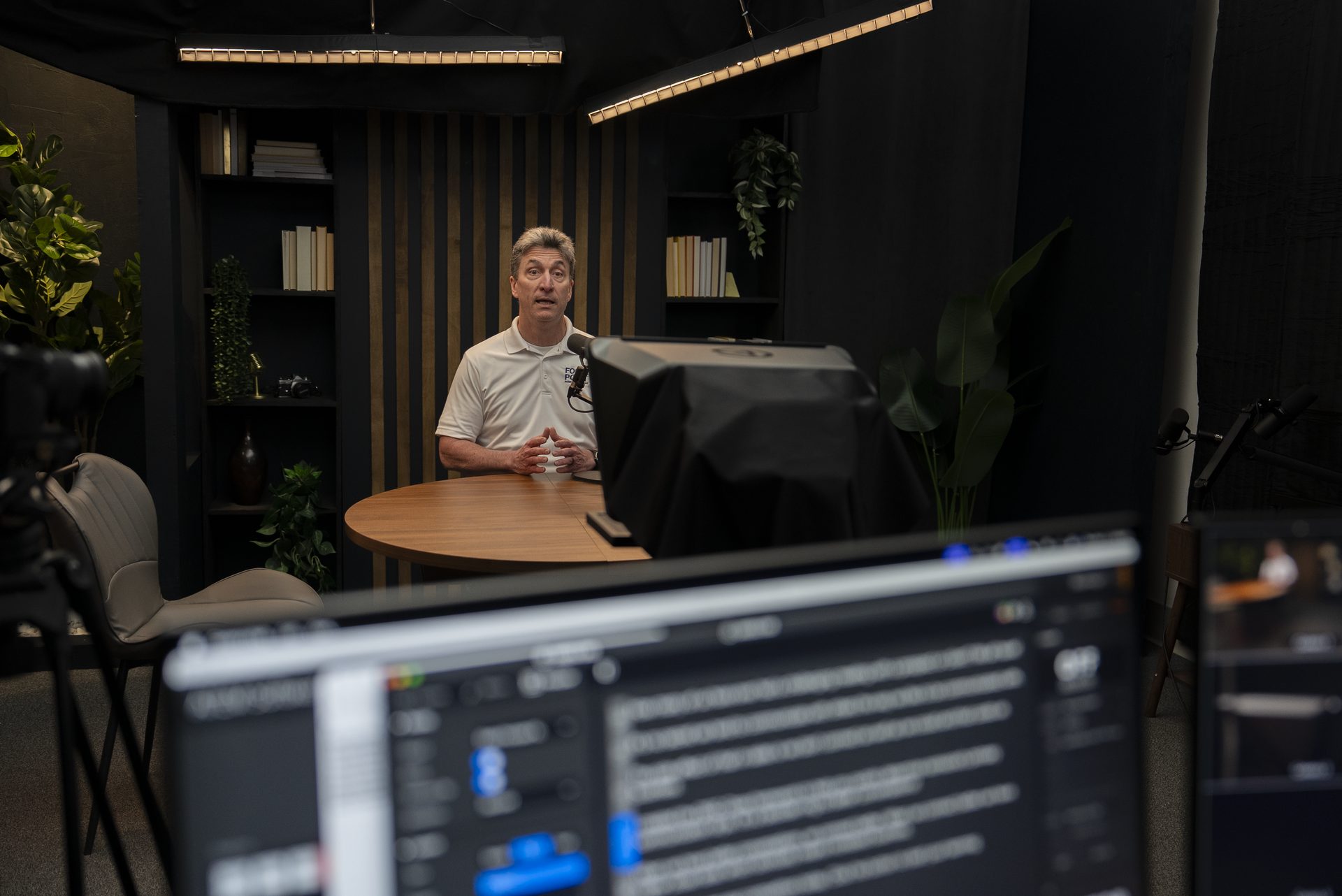
On recording day, CPS provides 4K multi-camera video, production-grade audio, professional lighting, and an on-site production team that handles all the technical details. Presenters show up, deliver their content, and leave. Post-production delivers upload-ready files — edited, captioned, and formatted for the LMS or course platform of their choice.
For organizations that want to extend the value of their course content, the same session can also produce short-form clips for internal promotion, LinkedIn, or email nurture sequences. One recording day, multiple content outputs.
If you're in Cincinnati, Northern Kentucky, or the Greater Cincinnati area and you're planning an eLearning or training video project, a Discovery Call is the right starting point. It's a no-obligation conversation about your project, your timeline, and whether a professional studio is the right fit. You can also contact us directly with any questions before you commit to anything.
The Cincinnati Business Podcast is an example of the long-form video production model CPS runs for its clients — same studio, same production team, same approach applied to course content.
FAQs: eLearning Video Production
What is eLearning video production?
eLearning video production is the process of creating professional video-based training content for online delivery — including scripting, recording, editing, and packaging modules for platforms like an LMS, internal portal, or course platform.
How long should eLearning videos be?
Most research points to 8-12 minutes per module as the sweet spot for completion and retention. Shorter is fine for micro-modules. Longer works for dense technical content, but should include clear chapter markers.
Do I need a professional studio to record eLearning videos?
Not always — but if your content has a shelf life of two or more years, if your brand reputation is tied to it, or if you're recording multiple modules efficiently, a professional studio environment pays for itself quickly.
What's the most common reason eLearning videos don't get completed?
Poor audio is the top culprit. Viewers will tolerate imperfect video more than distracting background noise or echo. After audio, it's lack of clear structure — modules that ramble without a defined outcome lose viewers fast.
Can you record a full eLearning course in one day?
Yes, with the right prep. A well-planned batch recording day at a professional studio can capture 8-12 modules depending on length. The key is arriving with a module-by-module run-of-show, not a full script.
What happens after we record at CPS?
CPS handles post-production — editing, sequencing, and delivering upload-ready files for your LMS or course platform. We can also produce short-form video clips from the session for internal promotion or social distribution.
Ready to Build Your Course Library?
The right production environment turns a training initiative into an asset that works for years. If you're planning an eLearning or corporate training video project and want to see how CPS handles it, start with a Discovery Call. We'll talk through your project, your audience, and what a professional batch recording day looks like for your specific use case.