
Why Your Short-Form Video Isn't Getting Engagement
Why Your Short-Form Video Isn't Getting Engagement (And How to Fix It)
You're posting short-form video. You're showing up consistently — or trying to. And the engagement just isn't there. A handful of likes, maybe a comment from someone you already know, and then silence. It's frustrating, and it's more common than most B2B teams want to admit.
The problem usually isn't what people think. It's rarely the platform, the frequency, or bad luck with the algorithm. Most of the time, it's a strategic gap in the content itself — and once you know what to look for, it's fixable.
Short-form video underperforms when the hook is weak, the audio is hard to follow, or the content is too generic to stop the scroll. The good news: these are all solvable problems, and fixing them doesn't require starting over.
Quick Answer
Short-form video underperforms when the hook is weak, the audio is hard to follow, or the content is too generic to stop the scroll. Most B2B teams produce clips that are technically fine but strategically empty — no specific promise, no clear viewer payoff. Fix the hook, sharpen the audio, and give every clip one focused idea. That's what separates clips that convert from clips that disappear.
The Real Reason Your Short-Form Video Isn't Getting Engagement
Algorithms are not random. They reward watch time, saves, and shares — and they punish fast drop-off. If people scroll past your video in the first two seconds, the platform takes that as a signal and stops pushing the content to new viewers.
Most B2B clips fail at second one. The opener is too slow, too vague, or too self-referential. "Hey everyone, today I'm going to talk about..." is not a hook. It's a reason to scroll.
This is a strategic problem, not a technical one. The teams that get traction on short-form video production aren't using better cameras — they're leading with better ideas. They understand that every clip needs to earn the watch in the first breath, deliver one clear payoff, and close with a specific next step.
The fix starts with understanding what's actually killing your engagement — and there are usually a few specific culprits.
The Six Engagement Killers (And What's Actually Causing Them)
Most underperforming clips share one or more of these problems. Run your last five videos through this list before you record another one.
1. A Weak Hook
Your first 1-2 seconds determine whether the algorithm shows your video to anyone beyond your immediate followers. A weak hook — one that's vague, generic, or self-focused — bleeds watch time before the content even starts.
Strong hooks do one of three things: they make a specific, surprising claim ("Most LinkedIn videos die in the first three seconds — including yours"); they ask a question that targets a real pain point ("Why does your short-form video get views but no leads?"); or they open a loop that the viewer has to close ("There's one thing missing from almost every B2B video I see"). Generic openers do none of these.
2. Audio That's Hard to Follow
Audio is the engagement variable most teams underestimate. Research published in PLOS ONE found that poor audio quality causes listeners to rate speakers as less intelligent, less credible, and less trustworthy — regardless of what the person actually says. On LinkedIn, where your clips compete against polished brand content, muddy audio doesn't just reduce engagement. It actively undermines authority.
Background noise, room echo, and low-fidelity USB microphones are the most common culprits. They're also the easiest to fix — if you're recording in a controlled environment.
3. No Focused Idea
Every clip that tries to make three points makes zero. The most-shared short-form content from B2B professionals is relentlessly narrow. One claim. One supporting example. One takeaway. If your topic sentence requires a comma, the clip is already too broad.
This discipline is harder than it sounds. Most professionals are trained to give comprehensive answers, not focused ones. Short-form video rewards the opposite instinct.
4. Inconsistent Posting
Algorithms reward consistent signals. A team that posts three times a week every week builds compounding reach. A team that posts in bursts and then disappears for two weeks does not — the algorithm treats each burst as a new account with no history.
The practical fix is batch production. One short-form video session at a professional studio can produce 10-20 clips in a single half-day — enough content to post consistently for 6-8 weeks without another recording day.
5. Wrong Clip Format for the Platform
LinkedIn, Instagram, and TikTok reward different things. LinkedIn audiences respond to insight-forward talking-head clips — specific claims backed by real experience. Instagram Reels favor energy, visual variety, and faster pacing. TikTok rewards personality and novelty. Repurposing the same clip without adapting it to the platform's native feel is a common reason clips underperform on one channel while the same content would work on another.
6. No Clear Call to Action
Viewers who don't know what to do next do nothing. "Follow for more" is not a CTA — it's noise. A specific ask (visit the link in bio, reply with your biggest challenge, book a Discovery Call) gives engaged viewers somewhere to go and signals to the algorithm that your content drives action, not just passive views.
How to Fix Short-Form Video Engagement: A Practical System
Fixing engagement isn't about producing more clips. It's about fixing the clips you're already producing. Start here.
Write the Hook Last
Most people write the hook first and then figure out the content. That's backwards. Record or outline your clip, figure out the single most compelling takeaway, and then write an opener that promises that specific payoff. A hook written backward from the punchline is almost always stronger than one written forward from a topic.
One Clip, One Idea — No Exceptions
Before you hit record, write out your clip's core claim in one sentence. If that sentence contains the word "and," you have two clips, not one. Separate them. The narrower and more specific the idea, the more likely it is to stop someone mid-scroll because it sounds exactly like something they've been thinking about.
This discipline compounds over time. Teams that consistently post narrow, specific clips build a library of content that reads like expertise. Teams that post broad, safe clips build a library that reads like a brochure.
Batch Record to Stay Consistent
Consistency is the variable that most teams treat as optional. It's not. Decide on a posting cadence — 2-3 times per week is right for most B2B LinkedIn audiences — and build the production system that makes that cadence sustainable without burning out your team.
Batch production is the practical answer. One half-day at a professional recording studio produces enough material for 6-8 weeks of consistent posts. Instead of scrambling to record something usable every week, your team shows up once, records a focused set of clips, and posts from that library until the next session. The Cincinnati Podcast Studio podcast team uses the same model — batch recording drives consistent output without constant setup time.
Match Format to Platform
Repurposing is smart. Repurposing without adaptation is lazy. Before you cross-post a clip, check whether the format, pacing, and tone match the platform's native feel. A LinkedIn clip that performs well often needs re-editing for Instagram — tighter pacing, more visual cuts, less corporate tone. The underlying insight can stay the same; the delivery often can't.
Close Every Clip With a Specific Next Step
Every clip that ends with "follow for more tips" is leaving engagement on the table. Replace it with a specific, low-friction ask: "Drop the word 'clips' in the comments and I'll send you the batch recording checklist we use with every client." Or: "If this resonated, there's a 20-minute Discovery Call where we can look at your specific situation." The more specific the ask, the more likely a genuinely interested viewer acts on it.
Why Production Environment Has More Impact Than Most Teams Think
Most B2B teams focus on content strategy and ignore production environment. That's a mistake — because the environment shapes the variables that drive engagement before you say a single word.
Audio Is the Credibility Signal You Can't Fake
The PLOS ONE research cited above isn't an outlier. Multiple studies confirm that audio quality is the single biggest driver of perceived speaker credibility in video content. Your potential clients are evaluating you while they watch. A professional short-form video setup with broadcast-grade audio doesn't just sound better — it makes you sound more authoritative, more credible, and more worth following.
A home office with a USB microphone and room echo signals the opposite, regardless of how good the content is.
Background Consistency Builds Brand Recognition
Every time you post a clip from a consistent, professional background, you're training your audience to recognize your content before they've read the caption. That recognition builds the kind of familiarity that B2B buyers need before they reach out. Inconsistent backgrounds — a different room every week, shifting lighting, no visual brand signal — undermine that accumulation.
Framing and Lighting Signal Production Value Instantly
Viewers make judgments about production quality in under a second. Eye-level framing, controlled lighting, and a clean background communicate that what you're about to say is worth the viewer's time. Poor framing — camera looking up from a laptop, harsh window backlight, cluttered background — communicates the opposite.
A professional studio removes all three variables permanently. You show up, record, and every clip looks like it belongs together — because it does.
How Cincinnati B2B Teams Build Clips That Consistently Perform
If you're running a B2B company in Greater Cincinnati or Northern Kentucky, here's the practical model that's working for teams here right now.
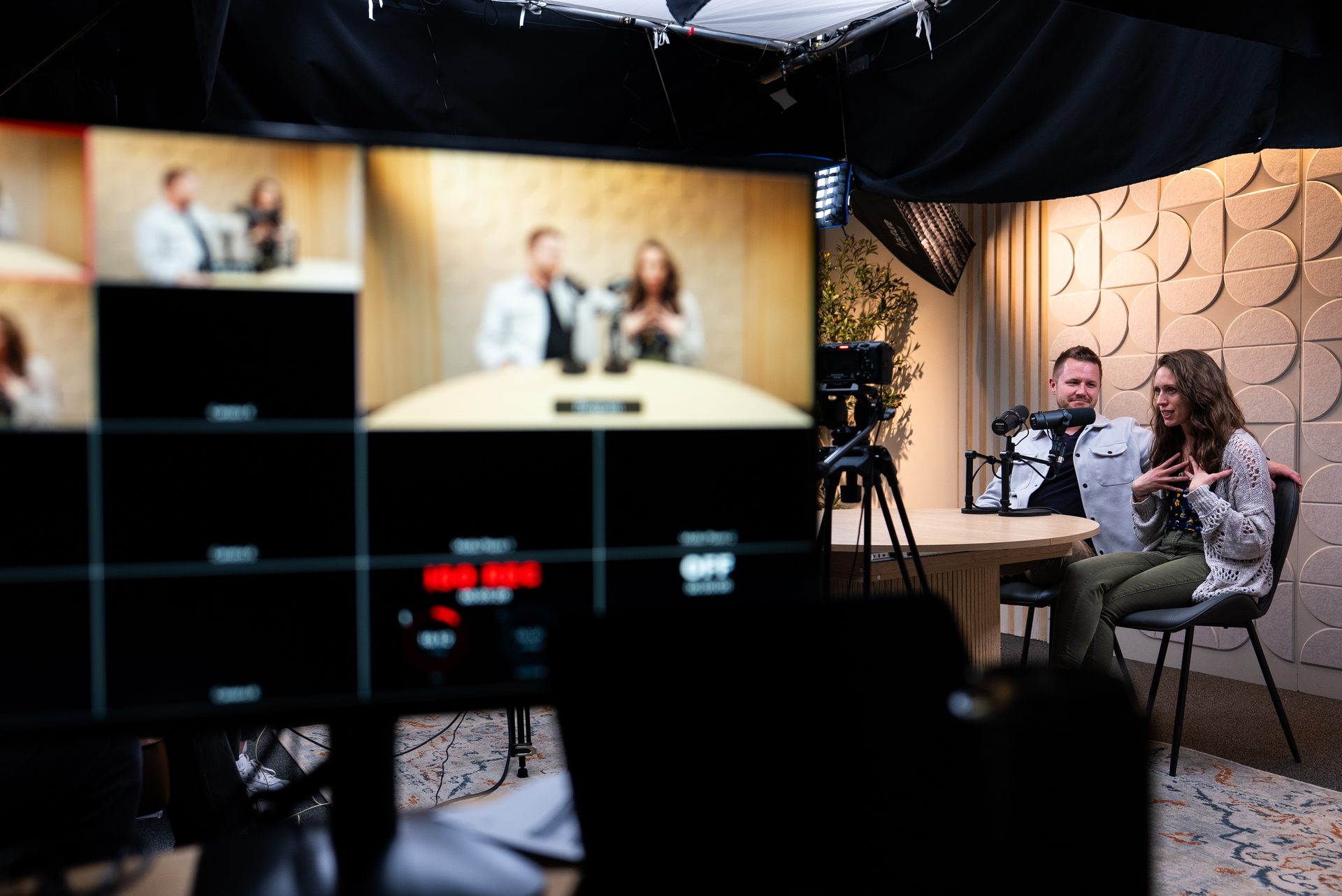
Instead of trying to record a clip whenever inspiration strikes, they book one batch session at Cincinnati Podcast Studio. They come in with talking points — not scripts — covering 10-15 topics they've been meaning to address. The production team at CPS handles framing, lighting, audio, and session flow. Most teams finish 10-20 usable clips in a half-day. That's 6-8 weeks of consistent posting from a single morning.
The clips are recorded in 4K with broadcast-grade audio, against a consistent studio background. Every post looks like it came from the same brand — because it did. And because they're posting consistently from a batch library, the algorithm treats them as an active, reliable signal rather than a sporadic one.
This model works for companies that have been trying to produce short-form video on their own and keep running into the same wall: it takes too much time, the quality is inconsistent, and the team never finds a sustainable rhythm. One session solves all three problems at once.
The Cincinnati Business Podcast is a good example of the batch production model applied to long-form content — the same principles that make podcast clips perform are what make standalone short-form clips work.
Common Mistakes to Avoid
- Posting the same clip on every platform without adapting it. Native format matters. What works on LinkedIn rarely works on TikTok without re-editing.
- Measuring success by views alone. Views tell you reach. Saves, comments, and DMs tell you resonance. Optimize for the latter.
- Waiting until you have perfect content to start posting. The only way to learn what works for your specific audience is to post, observe the data, and adjust. Perfection is a postponement strategy.
- Recording one clip at a time. The marginal effort to record clip number ten in a session is a fraction of recording clip number one. Batch recording is the highest-leverage operational change most teams can make.
- Treating short-form video as a standalone channel. Short-form clips perform best when they're connected to a larger content engine — a podcast, a webinar series, or a consulting-led content strategy — so each clip drives viewers toward a deeper relationship.
Frequently Asked Questions
Why is my short-form video not getting views?
The most common reason is a weak hook. If your first 1-2 seconds don't give viewers a specific reason to keep watching, the algorithm never shows it to anyone. Audit your last five clips and check whether the opening line promises a clear, specific payoff.
How long should a B2B short-form video be?
For LinkedIn, 45-90 seconds tends to perform best. Instagram Reels and TikTok can go shorter — 30-60 seconds for educational clips. The right length is whatever it takes to deliver one focused idea and a clear next step without padding.
Does video quality affect engagement on LinkedIn?
Yes. Research consistently shows that poor audio causes audiences to judge speakers as less credible and knowledgeable. On LinkedIn specifically, professional framing and clean audio signal authority before the content even starts.
How many short-form videos should I post per week?
For B2B, 2-3 times per week on LinkedIn is the right cadence for most teams — enough to stay present without flooding your audience. Consistency matters more than frequency. One batch recording session at a professional studio can produce 6-8 weeks of content at once.
What type of short-form video works best for B2B?
Insight-forward talking-head clips perform best on LinkedIn for B2B. Pick one specific claim, back it with a real example or data point, and close with a clear next step. Narrow and specific always outperforms broad and safe.
How do I get more engagement on short-form video without going viral?
Forget virality. B2B short-form video works on trust and repetition, not reach. Post consistently, pick specific narrow topics your audience cares about, and give every clip one concrete takeaway. Over 6-12 weeks, your algorithm footprint grows and so does engagement.
Ready to Build a Short-Form Video System That Actually Works?
If your short-form video isn't getting traction, the problem is almost always fixable — and fixing it starts with a clear strategy and a production setup that doesn't require heroic effort every week.
A Discovery Call with the CPS team takes about 20 minutes. We'll look at what you've been producing, what's not working, and what a batch recording session would actually produce for your business. No pressure, no sales script — just a straight conversation about whether the model makes sense for your situation.
If you're running a business in Cincinnati, Northern Kentucky, or the broader region and you're tired of short-form video that doesn't perform, reach out here or book directly through the Discovery Call link. We'll take it from there.
You can also explore our resources, learn more about our video podcasting services, or see how webinar production and course creation fit into the same batch recording model.