
Why Studio Soundproofing Matters More Than Most People Think
Why Studio Soundproofing Matters More Than Most People Think
Most businesses planning a podcast, webinar, or course recording focus on the camera and the message. Soundproofing rarely comes up until an episode sounds echoey, hollow, or noisy — and by then it's too late to fix without re-recording. The room you record in does more to shape how professional and credible you sound than almost anything else in the session.
In this article: what soundproofing actually does, why your audience judges your credibility by sound before they process your message, and what to look for in a properly treated studio.
Quick answer
Soundproofing controls echo, outside noise, and background hum that most people don't consciously notice but instantly judge as unprofessional. Research on audio perception has found that listeners rate the same information as less credible when the audio quality is poor, even when the words never change. A properly treated studio removes that credibility tax before you say a single word.
What soundproofing actually does (and what it doesn't)
Soundproofing and acoustic treatment solve two different problems, and most people conflate them. Soundproofing is about keeping outside noise out — traffic, HVAC systems, neighboring rooms, street noise. Acoustic treatment is about controlling what sound does once it's already inside the room — echo, reverb, and flutter off hard, parallel surfaces.
A room can be perfectly quiet and still sound bad. Most home offices and conference rooms have neither soundproofing nor acoustic treatment: hard walls, glass windows, and bare floors all reflect sound back into the microphone, creating the hollow, distant quality listeners associate with an amateur setup. A studio built for recording needs both pieces solved, not just a quiet space.
The research: why your audience judges credibility by sound, not just content
This isn't just a production preference — it's backed by research on how audio quality shapes perceived credibility. In a study published in Science Communication, researchers Eryn Newman and Norbert Schwarz found that when the exact same information was presented with degraded audio quality, listeners rated it — and the person delivering it — as less credible than when the audio was clean. The content never changed. Only the sound did.
For a B2B company trying to build trust with a prospect who has never met you in person, that's not a small detail. Viewers and listeners form a credibility judgment in the first few seconds of audio, often before they've consciously processed a single word of what's being said. A podcast, webinar, or course that sounds unpolished is working against itself before the content even gets a chance.
What happens when a space isn't properly treated
Untreated rooms create a predictable set of problems. Echo and room tone make speakers sound distant or hollow, like they're talking into a hallway instead of to the listener. Background hum from HVAC systems or street noise raises the noise floor, which forces heavier noise reduction in post-production — and that processing tends to make voices sound thin, robotic, or over-compressed, compounding the original problem instead of fixing it.
Prospects and clients pick up on this, often without being able to name why. A recording that sounds slightly off reads as an unpolished or less-established business, even when the message itself is strong. It's a credibility cost that's entirely avoidable with the right room.
What to look for in a soundproofed studio
Not every space marketed as a "podcast studio" has actually solved this problem. A few things to check before you book:
- Dedicated acoustic treatment — panels, bass traps, and diffusion placed for the room's specific dimensions, not just foam stuck on a wall
- A genuinely low ambient noise floor, with no HVAC rumble, street noise, or building hum bleeding into recordings
- A professional microphone setup matched to the treated room, since even a great microphone can't compensate for bad room acoustics
If you're a B2B team in Cincinnati or Northern Kentucky recording podcasts, webinars, or course content, this matters because prospects judge your credibility in the first few seconds of audio — before they've processed a word you've said.
Common mistakes businesses make trying to DIY it
Teams that try to solve this in-house tend to run into the same few issues. Buying foam acoustic panels but not treating low bass frequencies or sealing gaps around doors and windows leaves the underlying problem largely intact. Recording in a conference room or open office with hard, parallel walls amplifies echo rather than controlling it. And the most common mistake: assuming that a good microphone alone fixes a bad-sounding room. It doesn't — the room is doing most of the work, good or bad, before the microphone ever picks up a signal.
Why CPS treats acoustics as a non-negotiable for every session
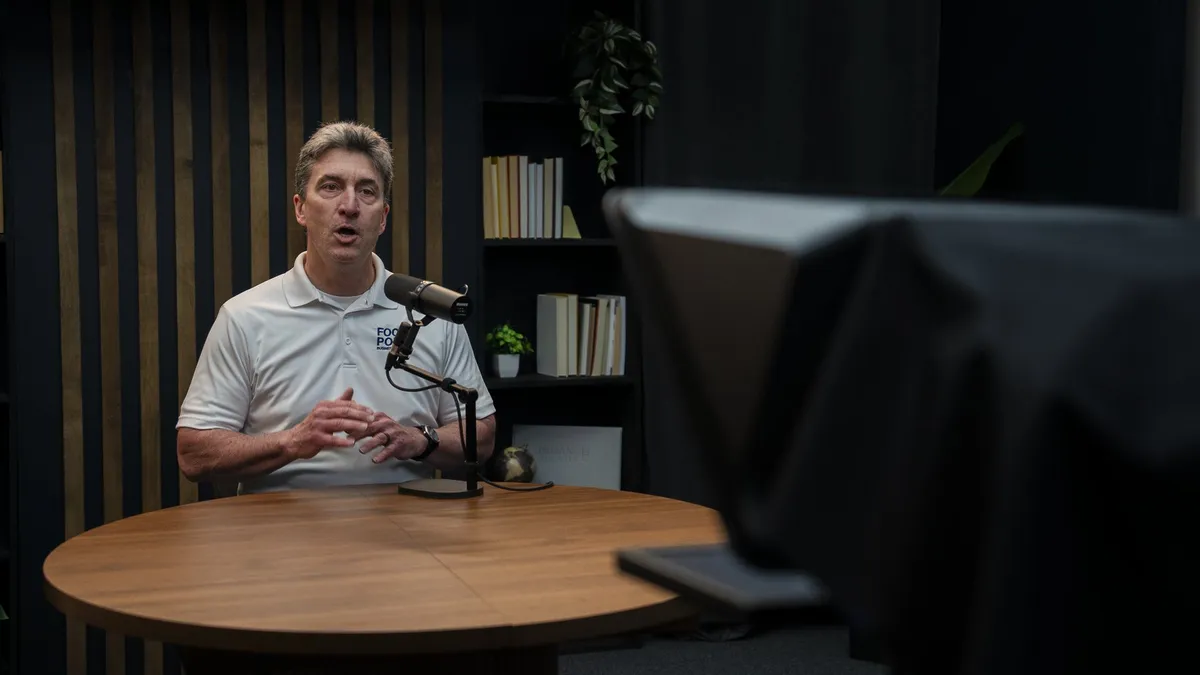
Cincinnati Podcast Studio's studio rental space is purpose-built and acoustically treated — not a converted office or conference room. That removes the guesswork, equipment investment, and trial-and-error from the client's side entirely: you show up and talk, and the room, microphones, and engineering are already solved.
This is also part of why CPS's batch recording model works. One well-treated session can produce a full episode for your video podcast studio lineup, content for webinar production, material for course creation, and clips for short-form video — and every piece sounds equally professional, because the acoustic foundation is the same for all of it. Businesses working with our content strategy consulting team often don't realize how much of their content's perceived quality comes down to the room until they experience the difference firsthand.
Want to hear the difference for yourself? Check out the Cincinnati Business Podcast, recorded entirely in CPS's treated studio, as an example of what a properly soundproofed room sounds like in practice.
FAQs
Is soundproofing the same thing as acoustic treatment?
No. Soundproofing keeps outside noise out; acoustic treatment controls echo and reverb inside the room. A professional studio needs both — a quiet room that still sounds bad is just as distracting as outside noise bleeding in.
Can I fix bad room acoustics in post-production editing?
Only partially. Noise reduction and EQ can reduce some problems, but heavy processing to fix echo or hum often makes voices sound processed or robotic. It's far better to record clean than to repair it afterward.
Does soundproofing really affect how trustworthy my business sounds?
Yes. Research on audio perception (Newman & Schwarz, 2018) found that identical information was rated as less credible when audio quality was poor, independent of the content itself. For B2B companies building trust with prospects, that's a real cost.
What's the difference between a home office and a real studio for this?
Most home offices and conference rooms have hard, parallel surfaces — walls, windows, tables — that reflect sound and create echo. A treated studio uses panels, bass traps, and a layout specifically designed to absorb and diffuse sound evenly.
Do I need to understand acoustics myself to get good audio?
No. That's the point of recording in a professional studio — the room, the microphone setup, and the engineering are already solved before you walk in. You show up and talk; CPS handles the acoustics.
The bottom line
Soundproofing and acoustic treatment aren't a production detail — they're part of how your audience decides, often unconsciously, whether to trust what you're saying. A room that hasn't solved this problem is working against your content before a single word is spoken.
If you want your next podcast episode, webinar, or course module to sound as credible as the message behind it, book a Discovery Call with Cincinnati Podcast Studio, or contact the CPS team to talk through your project. You can also schedule a Discovery Call to see the studio in person before you record.