
Where to Record Professional Videos: The Practical Guide
Where to Record Professional Videos (And What Actually Determines Quality)
Most people spend hours researching cameras and almost no time thinking about where they're going to record. That's backwards. The location — the acoustic environment, the lighting, the background — does more to determine how professional a video looks and sounds than the camera ever will.
If you're trying to figure out where to record professional videos, here's a practical breakdown of what each option actually delivers and what tends to go wrong.
Quick Answer
The best place to record professional videos is wherever you can control audio, lighting, and camera framing without distractions. For most business leaders, that means a dedicated studio — because home offices and conference rooms almost always introduce problems that are expensive to fix in post-production. If consistent quality matters, a professional studio rental gives you the fastest, most reliable path to a polished result.
Why Your Recording Location Matters More Than Your Camera
There's a persistent myth that a better camera solves most video quality problems. It doesn't. Viewers tolerate lower video resolution far more readily than they tolerate bad audio. And no camera setting fixes a cluttered background, a room that reverbs, or a window that blows out your exposure mid-sentence.
Location problems compound. A home office with decent natural light in the morning becomes overexposed by noon. A conference room that's quiet on Tuesday has HVAC noise all day Wednesday. When you're building a content library — episodes, modules, clips — inconsistency becomes a credibility problem. Audiences notice when your setup changes between videos, even subconsciously.
The decision of where to record isn't secondary to gear. It's the first decision, because everything downstream depends on it. If you're considering launching a video podcast studio in Cincinnati, starting with a controlled environment saves significant time and rework later.
The Most Common Places People Try to Record (And What Each Gets Wrong)
Most business teams cycle through a few options before they find what actually works. Here's what each one looks like in practice:
Home Office
The most accessible option and the most unpredictable. Home offices introduce ambient noise — HVAC systems, street traffic, pets, family members — that changes daily. Lighting depends on window placement and time of day. Backgrounds range from acceptable to actively distracting. The result is inconsistent from session to session, which makes it difficult to build a recognizable brand look.
A home setup can work, but it requires serious investment in acoustic panels, lighting equipment, and background staging. At that point, you're building a studio — it's just a private one.
Conference Room
Conference rooms are the default choice for corporate video, and usually the wrong one. Fluorescent overhead lighting is flat and unflattering. Conference room acoustics are designed for in-person conversation, which means hard surfaces that create echo on a microphone. The backgrounds — whiteboards, cluttered shelves, branded signage — read as generic and rushed.
You can improve a conference room with portable lighting and acoustic panels, but you're fighting the room's design every time. And if you're sharing the space, availability becomes an issue.
Co-Working Space or Rented Office
Some co-working spaces offer "podcast rooms" or media suites, but they're rarely optimized for video quality. You get the acoustic box, but not necessarily the lighting setup, the set design, or the production support that makes a session efficient. Results vary widely depending on the specific facility.
Dedicated Video Studio
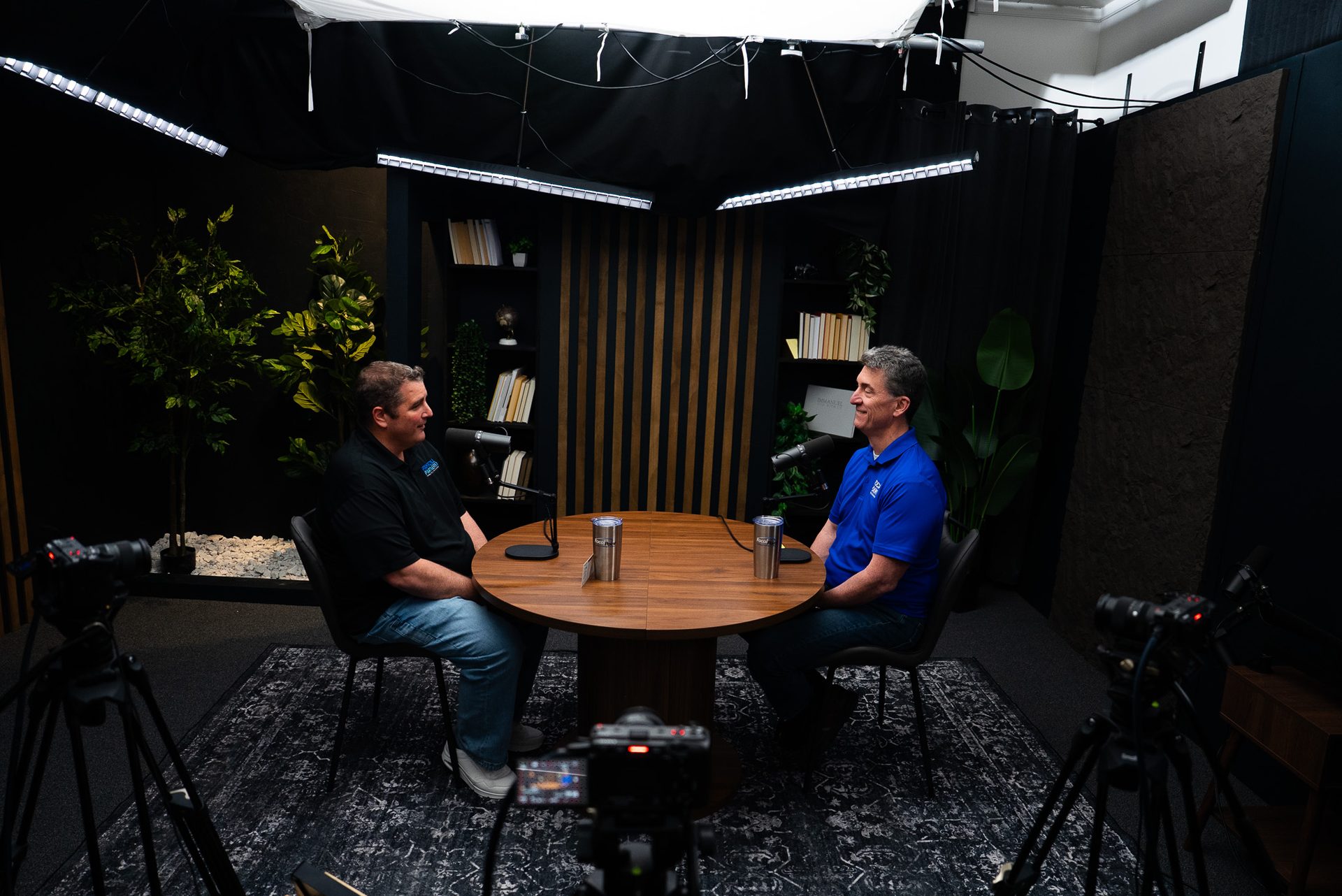
A purpose-built video studio solves the core problems: controlled audio, professional lighting, intentional set design, and production support. You show up prepared to talk. The team handles everything else. This is what makes batch recording sessions viable — producing 6-10 pieces of content in a single day instead of scheduling individual shoots across weeks.
What Makes a Space Actually Professional for Video
The word "professional" gets used loosely in this context, so it's worth being specific. A professional recording environment reliably delivers four things:
Acoustic Control
This means either acoustic treatment — panels, baffles, dense materials — or a naturally quiet space with no hard surfaces to create echo. The test: clap your hands in the room. If you hear any reverb or ring, the microphone will hear it too. Most untreated rooms fail this test.
Controllable Lighting
Natural light looks great in photographs. In video, it creates problems: it shifts throughout the day, it blows out one side of a frame when windows aren't blocked, and it's completely weather-dependent. Professional lighting means LED panels or studio strobes that you can position, diffuse, and color-balance to match on every session.
Clean, Intentional Background
The background in your video makes a statement about your brand before you say a word. A cluttered bookshelf, a visible door, or a busy open-plan office communicates informality at best and carelessness at worst. A professional setup includes either a designed physical set or a clean, neutral background that puts the subject front and center.
Camera Distance and Framing
Most rooms don't have enough depth. You need at least 8-12 feet between the camera and the subject for a flattering field of view, plus additional space behind the subject for background separation. Tight, cramped rooms create unflattering wide-angle distortion and flat backgrounds that read as DIY.
When a Dedicated Studio Is the Right Call
Renting a studio isn't the right answer for every use case. It makes the most sense when:
- Content quality directly reflects your brand. If you're a consultant, executive, or business owner whose credibility is on the line every time you publish, a polished video environment signals the same level of care you bring to your work.
- You're recording multiple pieces in one session. Batch recording — producing 4-6 podcast episodes, 10-20 short clips, or a full course module in a single day — is far more efficient in a studio than at home. The setup doesn't change between takes. You don't have to break down and rebuild your home setup each time.
- You want to show up and talk. Studio production support means you're focused on your message, not your mic gain or your lighting position. That focus shows in the final product.
- Consistency matters. For a video podcast, an online course, or a series of webinars, visual consistency builds audience familiarity. Same set, same lighting, same quality — session after session.
If you're in Greater Cincinnati or Northern Kentucky and want to see what a studio session actually looks like, the Cincinnati Business Podcast is a good reference — it's produced in the same studio our clients use.
What to Look for When Choosing a Recording Location
Whether you're evaluating a studio rental, a co-working media room, or your own home setup, here's what to assess:
- Acoustic treatment: Are there panels, soft surfaces, or enough room volume to minimize echo? Ask to clap in the room and listen.
- Lighting flexibility: Can you control the light placement and intensity? Are there windows that will cause problems at certain times of day?
- Background quality: What's in frame behind the subject? Is it intentional, clean, and on-brand?
- Camera and framing setup: Is the equipment already in place, or do you need to bring and configure your own?
- Production support: Is there someone managing audio levels, monitoring the recording, and flagging problems in real time — or are you handling all of that yourself while trying to present?
- Availability and booking: Can you get consistent access when your schedule requires it, or is the space shared in ways that create conflicts?
If you're evaluating professional studio rental options in Cincinnati, those six criteria will separate the right fit from a space that just checks a box.
For organizations producing webinar production, online course recording, or short-form video production, the same criteria apply — but the volume of content you're producing makes the case for a studio even stronger.
A Note for Cincinnati and Northern Kentucky Teams
If you're a B2B team in Cincinnati or NKY, you likely have clients and prospects who will see your video content before they ever meet you in person. The visual quality of that content is part of your first impression. Getting the recording environment right isn't a production detail — it's a brand decision.
We work with businesses across Greater Cincinnati who are producing everything from weekly podcast episodes to quarterly webinars to full course libraries. If you want to talk through what makes sense for your content goals, schedule a Discovery Call and we'll help you figure it out.
Frequently Asked Questions
Can I record professional videos at home?
You can, but most home environments introduce audio problems — HVAC noise, echo, street sounds, or random interruptions — that are difficult to fix in editing. The bigger issue is inconsistency: lighting and background change day to day. A dedicated studio solves all of this in a single visit.
Is a conference room good enough to record professional videos?
Conference rooms are usually the worst option. The lighting is fluorescent and flat, the acoustics are reflective, and the visual background is typically cluttered. The result looks corporate in all the wrong ways — rushed and generic rather than polished and intentional.
How much space do I need to record professional videos?
You need enough distance between the camera and the subject to create a flattering depth of field — typically 8-12 feet at minimum. You also need clearance behind the subject for background depth. Most spare offices and conference rooms fall short on both.
What does a professional video studio provide that I can't do myself?
Controlled audio, professional lighting, a clean and intentional set, and production support — so you can focus entirely on what you're saying. Studios also deliver consistency: every session looks and sounds the same, which builds audience trust and brand recognition over time.
Where should I record videos for LinkedIn and social media?
For short-form clips that represent your brand, a studio gives you the most reliable result. The framing, lighting, and audio hold up across formats — horizontal, vertical, and square — without extra work. One well-run studio session can produce 10-20 clips.
Does Cincinnati Podcast Studio offer video recording for things other than podcasts?
Yes. We record webinars, online courses, short-form social content, internal training videos, and more. The studio is built for any video content a business or expert wants to produce. A Discovery Call is the fastest way to figure out what fits your goals.
The Bottom Line
Where you record professional videos shapes everything downstream — how it sounds, how it looks, how consistently you can produce it, and how your audience perceives your brand. The location decision deserves more attention than the gear decision.
If you're ready to stop managing the environment and start focusing on what you're saying, schedule a Discovery Call with Cincinnati Podcast Studio. We'll walk through your content goals and show you what a professional studio session looks like from start to finish. You can also contact us directly with any questions.
Explore our content strategy consulting if you're still working out what to produce — and check out our resources for practical guides on building a content engine that doesn't require a full production team.