
What Makes a Video Studio Look Professional?
What Makes a Video Studio Look Professional?
You can always tell within the first few seconds. A professionally recorded video communicates credibility before a single word is spoken. But what actually creates that impression — and why does a home setup so often fall short, even with a decent camera?
The answer isn't about the gear. It's about the environment. Here's a breakdown of the four core elements that separate professional video studios from everything else.
A professional studio look comes down to four fundamentals: controlled lighting, intentional set design, acoustic treatment, and proper camera framing. Get all four right, and your content reads as broadcast-quality regardless of the platform it lives on.
Quick Answer
A professional video studio looks polished because of four core elements: controlled lighting that flatters subjects without harsh shadows, a clean and intentional set design, acoustic treatment that eliminates echo and room noise, and camera placement that frames subjects at eye level. When all four work together, the result reads as credible and high-production to any viewer.
Lighting: The First Thing Every Viewer Judges
Lighting is the single biggest visual separator between amateur and professional video. Viewers process it immediately — even if they can't articulate why one video looks polished and another looks flat.
A professional studio uses a three-point lighting setup: a soft key light as the primary source, a fill light to reduce harsh shadows on the opposite side of the subject's face, and a backlight or hair light to separate the subject from the background. Each element serves a specific purpose, and removing any one of them shows.
Overhead office lighting — the default in most homes and conference rooms — is one of the worst sources for video. It casts unflattering downward shadows, creates inconsistent color temperatures, and ages subjects on camera. Professional studios replace this entirely with purpose-built, diffused lighting rigs.
Color temperature consistency matters too. Mixing warm incandescent tones with cool daylight creates an unbalanced look that's hard to correct in post-production. A properly equipped studio controls every light source to achieve a consistent, flattering tone from shot to shot.
If you're recording video podcasting content or developing a multi-episode series, consistent lighting across every session also signals production quality to your audience. They may not know what three-point lighting is, but they'll feel the difference.
Set Design — What the Camera Actually Sees
Viewers don't just watch the person on camera — they read the environment around them. A cluttered background, a plain white wall, or an unlit backdrop all send low-production signals, regardless of how good the speaker is.
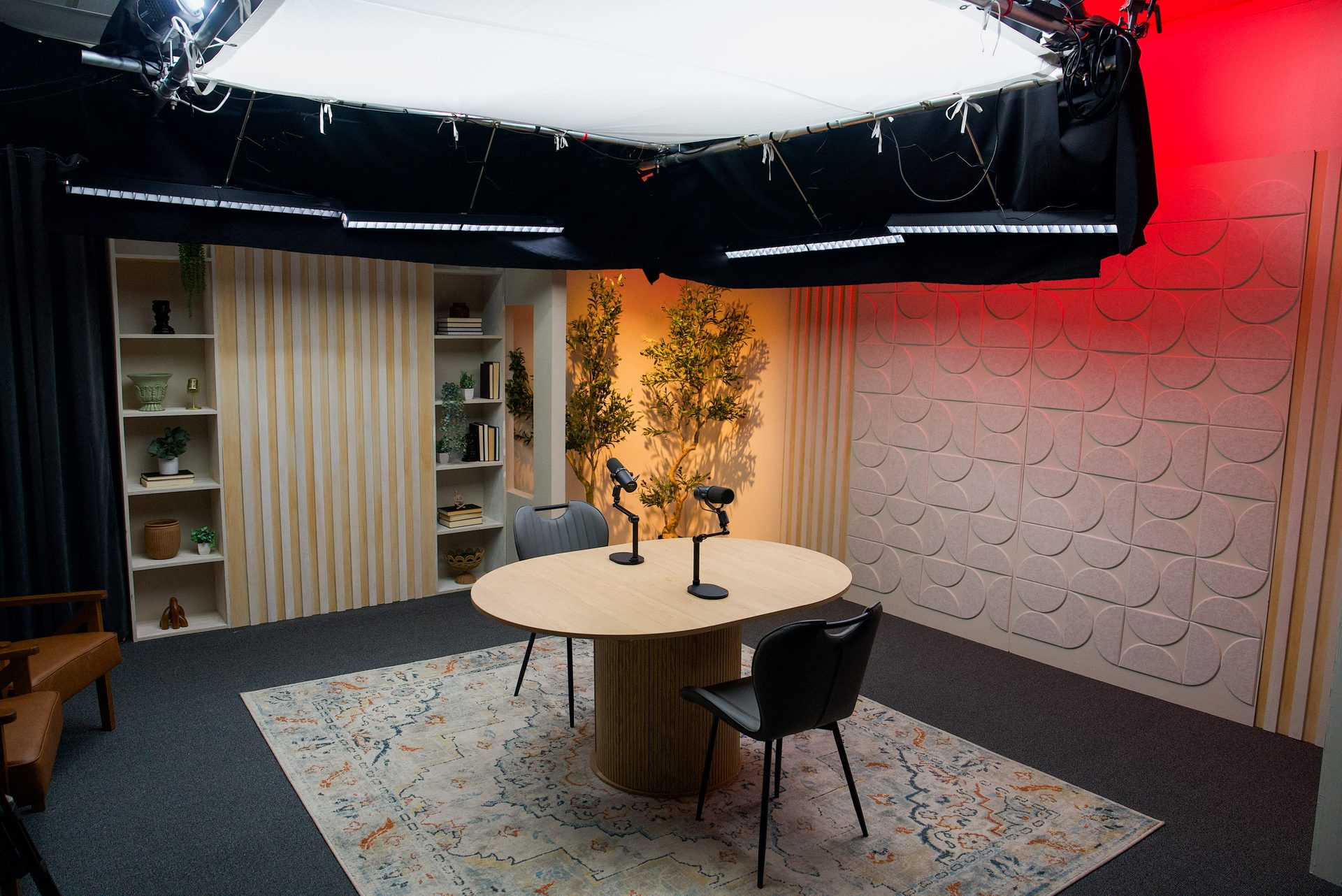
Professional set design is intentional, not accidental. Every element that appears in frame is considered: furniture placement, background depth, color palette, branded props, and negative space. The goal isn't to make the set look "fancy" — it's to make the subject look credible.
Depth is one of the most underrated set design principles. A flat background with no layers reads as cheap. A background with a foreground element, a midground set piece, and a lit backdrop looks dimensional and cinematic — even when recorded on the same camera.
Color is also strategic. The set palette should complement the speaker's typical wardrobe without clashing or blending into them. A subject who disappears into the background because their clothing matches the set is a set design problem, not a camera problem.
For businesses recording at a studio rental in Cincinnati, the set is already built and optimized. There's no guesswork about what's in frame, because every element has been selected and lit for camera.
Acoustic Treatment: The Element Most People Overlook
Audio quality has a disproportionate impact on perceived video quality. Viewers will tolerate mediocre video for excellent audio. They will not tolerate the reverse.
Most rooms were not designed with recording in mind. Hard floors, bare walls, and flat ceilings create reflections — the sound bounces around the room before reaching the microphone, producing a hollow, echoey quality that no amount of audio processing can fully fix. The solution isn't a better microphone; it's a better room.
Professional studios are acoustically treated from the ground up. Acoustic panels absorb reflections on walls and ceilings. Soft furnishings — rugs, upholstered seating, curtains — reduce high-frequency bounce. HVAC systems are isolated to eliminate background hum. The result is a "dry" recording environment where the microphone only captures what's in front of it.
This matters especially for webinar production and course creation, where the speaker's voice carries the entire production. A lecture or training video with poor audio quality undermines the instructor's authority — even when the content itself is excellent.
Acoustic treatment is also one of the most expensive and difficult elements to retrofit into an existing space. It requires soundproofing, absorption panels, and often structural changes. For most businesses, this is the clearest argument for using a purpose-built studio rather than trying to build one.
Camera Height, Angles, and Lens Choice
Camera placement communicates as much as the words being spoken. A camera positioned below eye level shoots up at the subject — a framing that reads as awkward at best, unsettling at worst. Eye-level framing is the professional standard because it mirrors natural human conversation and projects confidence.
Focal length affects how the background renders. A longer lens (85mm or above on a full-frame camera) compresses the background and produces the soft, blurred backdrop common in high-end video productions. A wide lens at close range distorts faces and makes backgrounds appear sharp and distracting. Professional studios choose lenses appropriate for the subject distance and desired look — not whatever happens to be available.
Multiple camera angles add production value to long-form content. A two-camera interview setup allows for natural cuts between a wide two-shot and individual close-ups, which is standard for any polished podcast or video interview. A single, static camera with no cut points reads as a recording — not a production.
For businesses creating short-form video content, the right camera framing also determines whether clips edit cleanly. Poorly framed wide shots rarely produce tight, social-ready clips. Professional studios set up primary and secondary cameras specifically to give editors flexibility in post-production.
How to Access a Professional Studio Without Building One
Most businesses don't need to own a studio — they need access to one. Building a professional video studio requires significant capital investment in lighting equipment, acoustic panels, set furniture, cameras, and production infrastructure. For businesses that record content periodically — not daily — this rarely makes financial sense.
A studio rental gives you broadcast-quality results without that investment. When you walk into a professionally equipped studio, the lighting is already set, the set is already dressed, the acoustics are already treated, and the cameras are already positioned. The only variable you bring is the content itself.
At Cincinnati Podcast Studio, we've built the space so that businesses in Greater Cincinnati and Northern Kentucky can show up, have a real conversation, and leave with production-ready content. Our team handles the technical side — camera operation, lighting adjustments, audio monitoring — so you can focus entirely on what you're saying, not how it looks.
Many of our clients record a full episode, multiple short-form clips, and standalone social segments in a single session. Consulting on content strategy is also available if you want help planning what to record before you show up.
If you're based in Cincinnati, Northern Kentucky, or the surrounding area, this is one of the highest-leverage investments you can make in your content quality — without the overhead of owning the equipment yourself.
Frequently Asked Questions
What is the most important element in a professional video studio?
Lighting is typically what viewers judge first. A well-lit subject in front of a clean background will look professional even on modest cameras. Without controlled lighting, even expensive equipment produces mediocre results.
Do I need a dedicated room to get a professional-looking studio?
Not necessarily. What you need is control over light, sound, and background — which is much easier in a purpose-built space. A studio rental gives you all three without the cost of building out a room permanently.
Why does my home studio look unprofessional even with a good camera?
Camera quality is usually the last variable that matters. The bigger culprits are lighting (harsh overhead fixtures), background (cluttered or flat walls), and acoustics (echo from hard surfaces). Fix those first.
How many cameras should a professional video studio have?
For most business content, two cameras are the minimum for polished results: one primary wide shot and one closer angle. A three-camera setup adds production flexibility for interviews and panel conversations.
Can I record a podcast and short-form video clips in the same studio session?
Yes — and this is one of the most efficient ways to produce content. A properly equipped studio lets you record your long-form episode and capture standalone short-form clips in a single session, maximizing your output per hour.
Is renting a video studio worth it for a small business?
For most small businesses, renting is significantly more cost-effective than building. A professional studio rental gives you broadcast-quality results on demand without the capital expense of equipment, lighting, acoustic treatment, and set design.
Ready to See What a Professional Studio Looks Like in Person?
If you want to understand what makes a studio professional, the fastest way is to walk into one. The difference between a purpose-built production environment and a conference room or home setup becomes immediately obvious.
We work with B2B organizations, entrepreneurs, and content creators across Cincinnati and Northern Kentucky. Whether you're launching a podcast, recording a course, producing webinar content, or building a short-form video library, the quality of your studio environment determines the quality of everything that comes out of it.
Book a Discovery Call to talk through what you're building and whether our studio is the right fit. You can also contact our team with questions, or browse the Cincinnati Business Podcast to see the kind of content our clients produce.