
Virtual Event Production Cincinnati | CPS
Virtual Event Production in Cincinnati: How to Stop Looking Like Everyone Else on Zoom
You spent weeks preparing the content. You wrote the agenda, briefed the speakers, and promoted the event. Then it went live — and the first thing your audience noticed was the background clutter, the echo on the audio, and the pixelated feed every time someone shared their screen.
That's the virtual event production gap. The content was solid. The presentation wasn't. And in a world where your audience has seen thousands of hours of professional video, the technical quality of your event communicates something about your organization before you've said a word.
Professional virtual event production means pairing great content with broadcast-quality delivery — so the audience stays focused on what you're saying, not on the distractions around it.
Quick Answer
Virtual event production means running your online event — town hall, product launch, investor update, or summit — with broadcast-quality video, professional audio, and a production team managing the technical side. Instead of a laptop and a ring light, you get 4K cameras, studio lighting, clean audio, and someone handling the stream so you can focus on the content. The result is an event that reflects your brand accurately and keeps your audience engaged from start to finish.
What Virtual Event Production Actually Means
Most people think of virtual event production as the platform — Zoom, Teams, Hopin, StreamYard. The platform is the delivery mechanism. Production is everything your audience experiences when they tune in.
A fully produced virtual event includes:
- Camera and video quality — 4K multi-camera capture, not a laptop webcam
- Audio — broadcast-grade microphones, properly positioned and mixed, so every speaker sounds clear
- Lighting — professional studio lighting that makes presenters look composed and credible
- Background and staging — a controlled studio environment, not a home office or conference room with visual noise
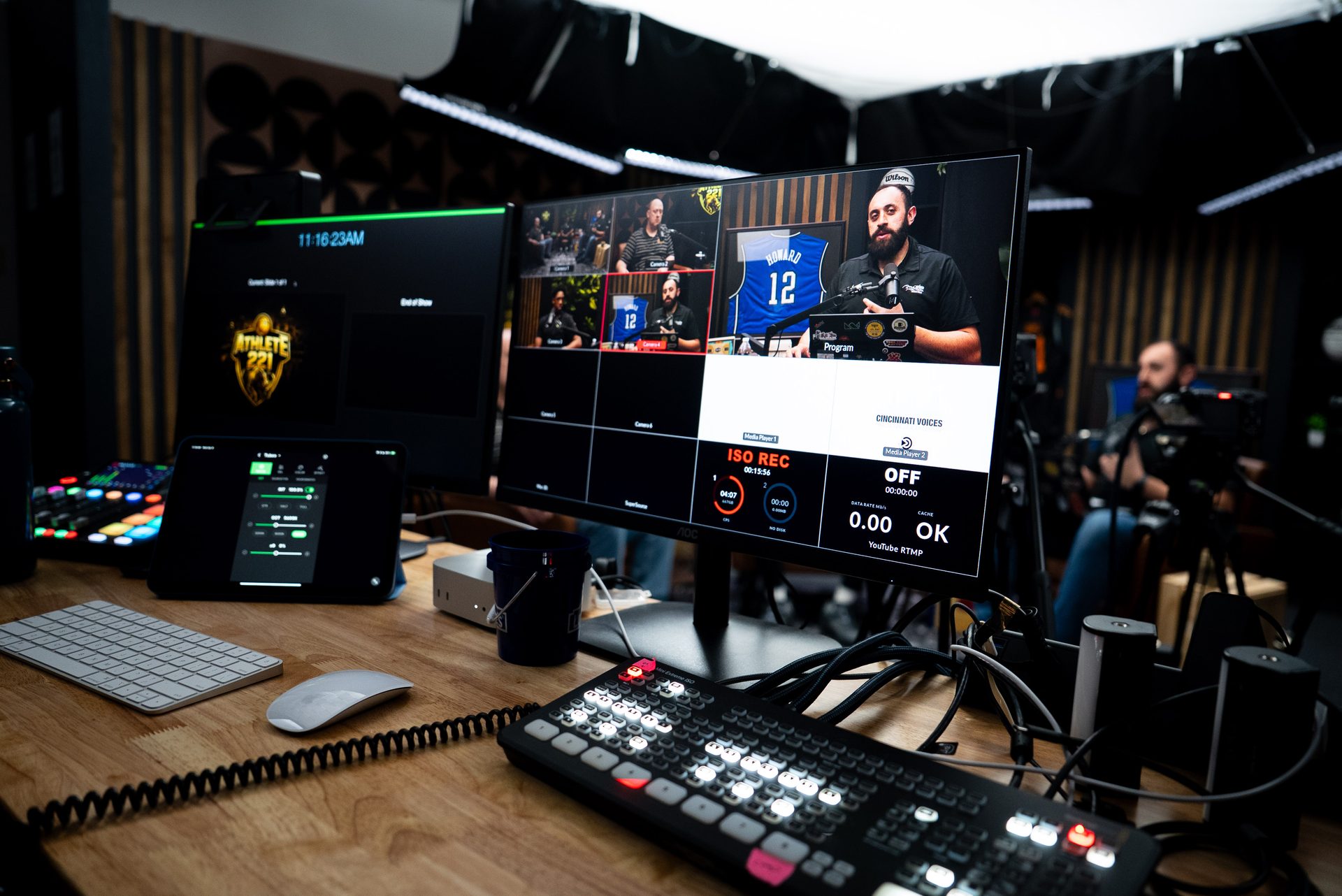
- Live production direction — someone switching cameras, managing the stream, troubleshooting tech in real time, and integrating slides or screen share cleanly
When all of those elements are handled professionally, the audience's experience shifts. They stop noticing the format and start absorbing the message. That's the goal of webinar production at CPS.
Types of events that benefit most from professional production:
- Company town halls and all-hands meetings
- Product launches and demos
- Investor and analyst updates
- Association member summits and conferences
- Paid virtual workshops and training programs
- Executive Q&As and leadership panels
- Customer education webinars
If your audience needs to trust you — or if they're paying to attend — the production quality matters. Book a Discovery Call to talk through what your event needs.
Why DIY Virtual Events Fall Short
The problem with most virtual events isn't the content. It's the environment the content is delivered from. DIY setups introduce four consistent failure points that professional production eliminates.
Audio breaks trust first
Before your audience processes what you're saying, they process how it sounds. Room echo, HVAC hum, inconsistent microphone positioning, and compression artifacts from a laptop mic all signal the same thing: this wasn't prepared. Research from PLOS ONE on audio quality and perceived speaker competence shows that poor audio quality directly lowers how credible the speaker appears — even when the content is identical. That's a problem if your event is trying to build trust.
Background inconsistency
When each speaker is in a different location with a different background and different lighting, the visual fragmentation makes the event feel informal — even when the topic is serious. A controlled studio environment with consistent staging eliminates that problem entirely.
No backup when things go wrong
Internet drops. Screen shares freeze. Audio cuts out mid-sentence. In a DIY setup, these problems surface live, in front of your audience, with no one handling them. A production team has contingency plans — backup connections, hardware failover, and someone whose entire job is to keep the event running smoothly.
Multi-speaker coordination
Panel events and multi-speaker formats are where DIY falls apart fastest. Managing audio levels, camera switching, speaker cues, and Q&A logistics simultaneously is a full-time job during a live event. The podcast production experience we've built at CPS applies directly here — coordinating multiple speakers in a high-quality live environment is something we do every day.
What a Professional Virtual Event Setup Includes
When you host a virtual event from a professional studio, the production infrastructure is already in place. Here's what a fully equipped setup includes — and why each element matters.
4K multi-camera capture
A single locked-down camera is fine for a simple talking-head recording. For a live event, multi-camera capture lets the production team cut between angles — wide shots that give context, close-ups for emphasis, two-shots for panel conversations. It makes the event feel dynamic without requiring the presenter to do anything differently.
Broadcast-grade audio per speaker
Every speaker gets their own dedicated microphone, properly positioned and level-matched. Whether you have one presenter or a four-person panel, every voice comes through clean and consistent. No echo. No hot mics. No surprises when someone turns their head.
Professional lighting
Studio lighting isn't just about looking polished. It's about consistency — the same look from shot to shot, presenter to presenter. Good lighting also eliminates the tired, washed-out look that most webcam setups produce under fluorescent overhead lights.
Live production direction
This is the element most organizations underestimate. A live production director is watching every feed, managing the switcher, cueing transitions, integrating screen shares or slides, monitoring stream health, and troubleshooting anything that comes up — all in real time. It's the difference between an event that flows and one that stumbles publicly.
Recording for repurposing
Every session at Cincinnati Podcast Studio is recorded at full broadcast quality. That recording becomes the raw material for on-demand replay, short-form video clips, transcripts, blog posts, email series, and training assets. One production session can fuel months of content.
Who Uses Professional Virtual Event Production
The organizations getting the most out of professional virtual event production tend to fall into a few clear categories.
B2B companies with high-stakes communication
Investor updates, analyst briefings, partner summits, and customer education events all carry implicit stakes. The quality of your production communicates how seriously you take the audience's time. For Cincinnati-area companies competing for credibility with national or global audiences, professional production levels the playing field.
Professional associations and member organizations
Associations that run annual summits, continuing education webinars, or leadership conferences increasingly face the expectation of broadcast-quality production. Members who watch professionally produced content in every other context are quick to notice when an event doesn't meet the same standard.
HR and L&D teams scaling training
Organizations that need to train distributed teams efficiently use recorded virtual events as scalable training assets. When those recordings need to be watched repeatedly over months or years, the production quality matters significantly more than it would for a one-time live event. Our course creation services support this use case directly.
Consultants and coaches running paid virtual workshops
When attendees pay to participate, the production quality is part of what they're paying for. A paid virtual workshop recorded and delivered from a professional studio signals that the host takes the value exchange seriously.
If you're a B2B team in Cincinnati or the surrounding area — including Northern Kentucky, Dayton, and the Greater Cincinnati region — and you're running events where brand perception matters, professional production is the practical choice. Our consulting and content strategy team can help you think through the full content system around your event.
How to Get More From Your Virtual Event
The mistake most organizations make is treating a virtual event as a one-time live experience. A professionally produced event is actually a content production session. Here's how to extend the return on a single recording day.
- On-demand replay: Post the full recording for registrants who missed the live session or want to rewatch specific segments. On-demand access extends the event's value for weeks after the live date.
- Short-form clips: A 60-minute event contains 8-15 clip-worthy moments — a pointed answer, a surprising stat, a clear framework. Those clips perform on LinkedIn, YouTube Shorts, and Instagram, and they drive registrations for your next event.
- Blog post from the transcript: A clean transcript from a well-produced event is a ready-made content asset. Run it through a structured edit and you have a high-value SEO article on the topic your event covered.
- Email series from the Q&A: The questions your audience asked during the event are the exact questions they were searching for answers to. Turn the Q&A section into an email nurture sequence or an FAQ resource page.
- Training module: For internal events, a cleanly recorded session is a reusable training asset. Instead of running the same onboarding session twelve times, record it once at broadcast quality and distribute it through your LMS.
Explore our content resources for more on building a content system around your production sessions. And check out how Cincinnati-area businesses are putting these strategies to work on the Cincinnati Business Podcast.
Frequently Asked Questions
What is virtual event production?
Virtual event production is the professional management of the technical and visual side of an online event — cameras, audio, lighting, streaming, and often a live production director who handles switching and troubleshooting so the presenter can focus on the content.
What kinds of virtual events benefit from professional production?
Any event where the audience's impression of your brand matters: town halls, product launches, investor updates, association summits, training sessions, paid virtual workshops, and executive Q&As.
Can I host my virtual event from a professional studio?
Yes. Hosting from a studio gives you broadcast-quality video and audio, a production team on site, and a controlled environment. Your attendees see a polished, consistent presentation — not a home office with ring-light shadows.
How is virtual event production different from just using Zoom?
Zoom handles the connection. Production handles everything the audience sees and hears — camera quality, lighting, audio clarity, background, and technical backup if something goes wrong. Most attendees can tell the difference within the first 30 seconds.
What does a virtual event production session include at CPS?
A dedicated studio with 4K cameras, broadcast-grade audio, professional lighting, and an on-site production team. We also record the session for repurposing into clips, transcripts, and on-demand replay.
Can I repurpose my virtual event content?
Absolutely. One virtual event session can yield: a full recording for on-demand replay, 5-15 short video clips, a transcript, a blog post, a slide deck companion, and an email series from the Q&A.
What to Do Next
If you have a virtual event coming up — or if you've been running events on a DIY setup and want to see what professional production actually looks like — the next step is straightforward.
Book a Discovery Call with the Cincinnati Podcast Studio team. We'll talk through your event format, your audience, what you want to walk away with, and whether our studio is the right fit. No pressure, no pitch — just a clear picture of what's possible.
You can also contact us directly if you have specific questions about setup, technical requirements, or what a production session costs for your event type.