
Does Video Quality Affect Online Course Completion Rates?
Does Video Quality Affect Online Course Completion Rates?
Most course creators obsess over curriculum and spend almost no time thinking about how the course actually looks and sounds. That's backwards. By the time a student is deciding whether to keep watching, the content hasn't even had a chance to prove itself yet — the production already has.
If you're building or refreshing a course, training library, or internal learning program, the production decisions you make before you hit record are quietly deciding how many students make it to the end.
Quick Answer
Yes. Research on instructional video shows production quality changes how students perceive content, how long they stay engaged, and how likely they are to finish. Poor audio, inconsistent lighting, and static camera angles increase drop-off, while clear audio, steady visuals, and tight pacing keep students watching to the end.
What the Research Says About Video Quality and Completion
A study published in the Journal of Educators Online compared learner outcomes between higher production-value video and lower production-value video using identical scripts and instructors. The production quality itself, not just the content, changed how viewers engaged with and responded to the material.
That lines up with what we see producing course and training video for B2B companies and consultants across Cincinnati and Northern Kentucky: completion is a trust signal before it's a content signal. Students decide in the first few seconds whether this is worth their time, and production quality is doing most of that talking.
Why Students Quit Courses Before the Content Is Even the Problem
Bad audio is the single fastest way to lose a learner. A muffled laptop mic or inconsistent volume between sections reads as low effort within seconds, regardless of how good the material is.
Visual monotony is a close second. A static webcam shot with no movement, no b-roll, and no visual variety asks the viewer to supply all the energy themselves. Most won't.
The first two minutes of a course set the completion trajectory for the whole thing. If audio and visuals feel amateur out of the gate, students assume the rest of the course will be too — and they stop giving it the benefit of the doubt.
The Production Factors That Move the Needle Most
You don't need a Hollywood budget to fix most of this. A handful of factors consistently drive the difference between a course people finish and one they abandon:
- Clean, consistent audio. A proper lav or boom mic, not a laptop or webcam mic, eliminates the single biggest drop-off trigger.
- Steady, well-lit video. You don't need multiple angles to start — you need a camera that's framed well, lit evenly, and doesn't shake or auto-focus hunt.
- Section length matched to attention, not convenience. Shorter, focused segments outperform one long lecture split arbitrarily by a calendar.
- Visual pacing. B-roll, slides, or an occasional angle change every few minutes keeps a static talking-head format from feeling like a lecture hall recording from 2004.
What This Looks Like in a Real Recording Session
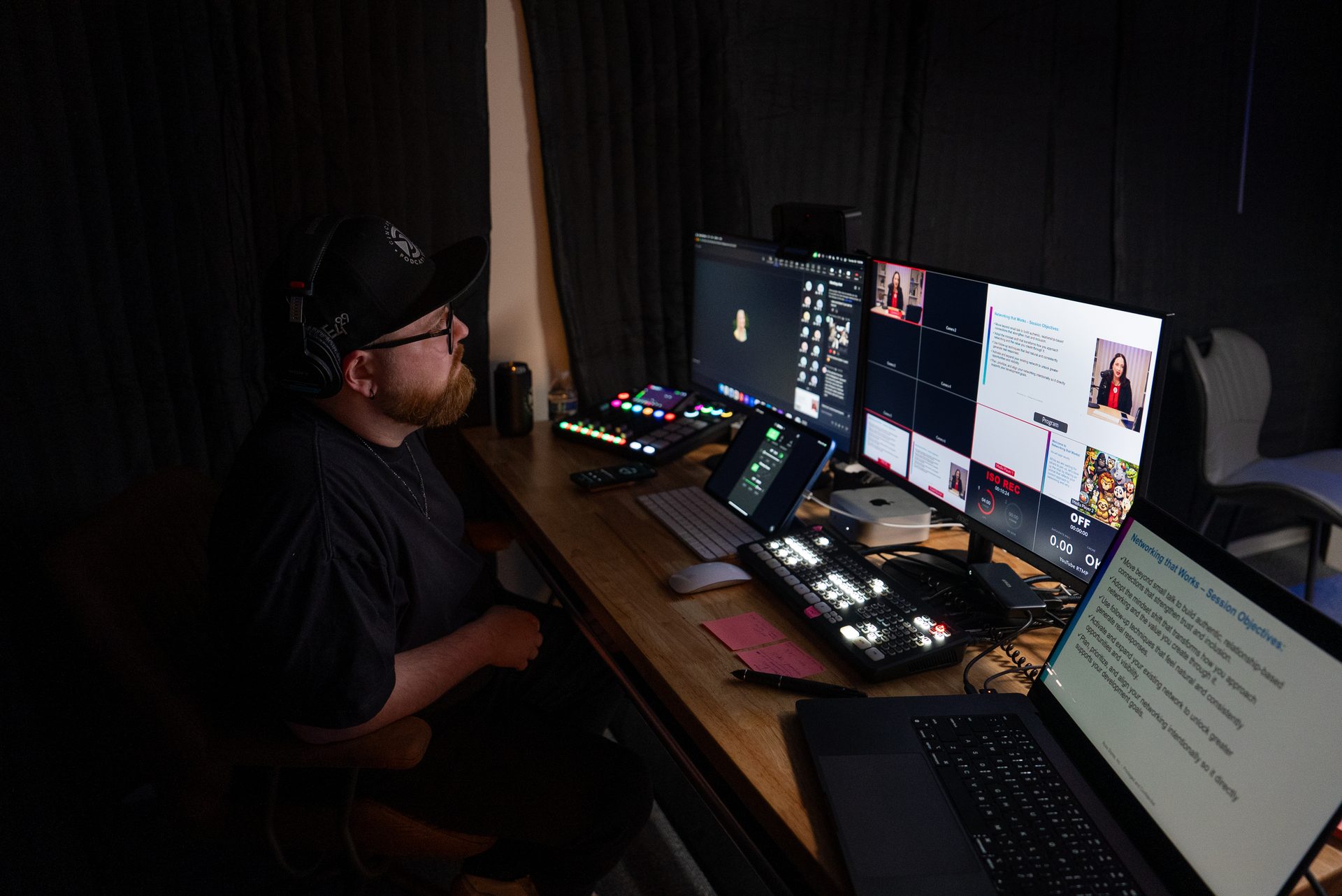
There's a real difference between recording a course piecemeal on a laptop between meetings and batch-recording it in a single studio session with a professional crew handling lighting, audio, and camera.
Same instructor, same script, same content — but one version keeps students watching and the other doesn't. That's the whole premise behind course creation production at CPS: the creator shows up and teaches, and the production team handles everything that determines whether students stick around to hear it.
If you're a B2B team, consultant, or training department in Cincinnati or Northern Kentucky, this matters because your course or training library is often someone's first real exposure to how your company operates. A course that looks rushed undercuts the authority you're trying to build.
Common Mistakes That Quietly Tank Completion Rates
- Recording course video the same way as an internal Zoom call. Internal meetings tolerate rough audio and bad lighting. Paying students don't.
- Skipping a teleprompter. Without one, instructors lose energy and pacing mid-take, and it shows on screen.
- No real editing pass. Dead air, filler words, and long pauses that felt fine live feel endless on playback.
Most of these aren't content problems. They're production problems with a content-shaped symptom — and they're fixable before you ever hit record, not after.
Frequently Asked Questions
Does video quality really change whether someone finishes a course?
Yes. Studies on instructional video show production quality affects perceived credibility and sustained attention, both of which are tied directly to completion.
What's the single biggest production mistake that hurts completion?
Bad audio. Viewers tolerate imperfect lighting far more than they tolerate hard-to-understand or inconsistent sound.
Do I need multiple cameras to record a good course?
No. A single steady, well-lit, well-framed camera with clean audio outperforms a shaky multi-cam setup. Multiple angles help with pacing but aren't required to start.
How long should each course video section be?
Shorter is generally safer. Breaking content into focused segments rather than one long lecture keeps attention and makes the course easier to resume.
Can I fix a low-production course after the fact?
Editing can clean up pacing and cut dead air, but it can't fix bad audio or lighting captured at recording time. It's cheaper to get the recording right the first time.
Where to Go From Here
If your course, training library, or onboarding content is underperforming and you suspect production might be part of it, that's worth a conversation before you record another session. We cover the batch-recording model, equipment, and planning process in more detail in our guide on short-form video production and in our broader consulting and content strategy work, and you can hear how other Cincinnati-area businesses think about content on the Cincinnati Business Podcast.
If you'd rather just get it recorded right the first time, start with a Discovery Call. We'll walk through your course or training goals and what a professionally produced recording session looks like, including studio rental options if you want to bring your own setup. You can also reach out directly through our contact page or explore podcast idea research if video content is part of a bigger strategy question.