
Podcast vs. Video: What Should B2B Leaders Create?
Should I Start a Podcast or Make Videos? What B2B Leaders Need to Know
Business leaders ask us this question every week. They've decided it's time to show up online with more intentional content, but they're stuck at the fork in the road: podcast or video? The good news is that the question itself is based on a false assumption. The better question is how to produce both without doubling your workload.
Here's what we've learned working with B2B founders and executives across Cincinnati and Northern Kentucky: the format matters less than consistency, and the right production setup can eliminate the need to choose at all.
This guide breaks down the real differences between audio podcasting and video content, the case for each, and the strategy that delivers the highest return for most business leaders.
Quick Answer
For most B2B leaders, video podcasting gives you the best return because it produces both formats at once — audio for the podcast feed and video for YouTube and social media. If you record on camera, you don't have to choose. But the right answer depends on your audience, your bandwidth, and what you can commit to consistently.
Why This Question Comes Up (And Why It's the Wrong Frame)
The podcast-or-video question usually comes from a scarcity mindset: limited time, limited budget, and the assumption that each format requires a completely separate workflow. That assumption is outdated.
Most business leaders picture podcasting as an audio-only medium — microphone, headphones, an RSS feed. They picture video as a whole different production — cameras, lighting, editing software, social media management. From that lens, choosing feels like a real tradeoff.
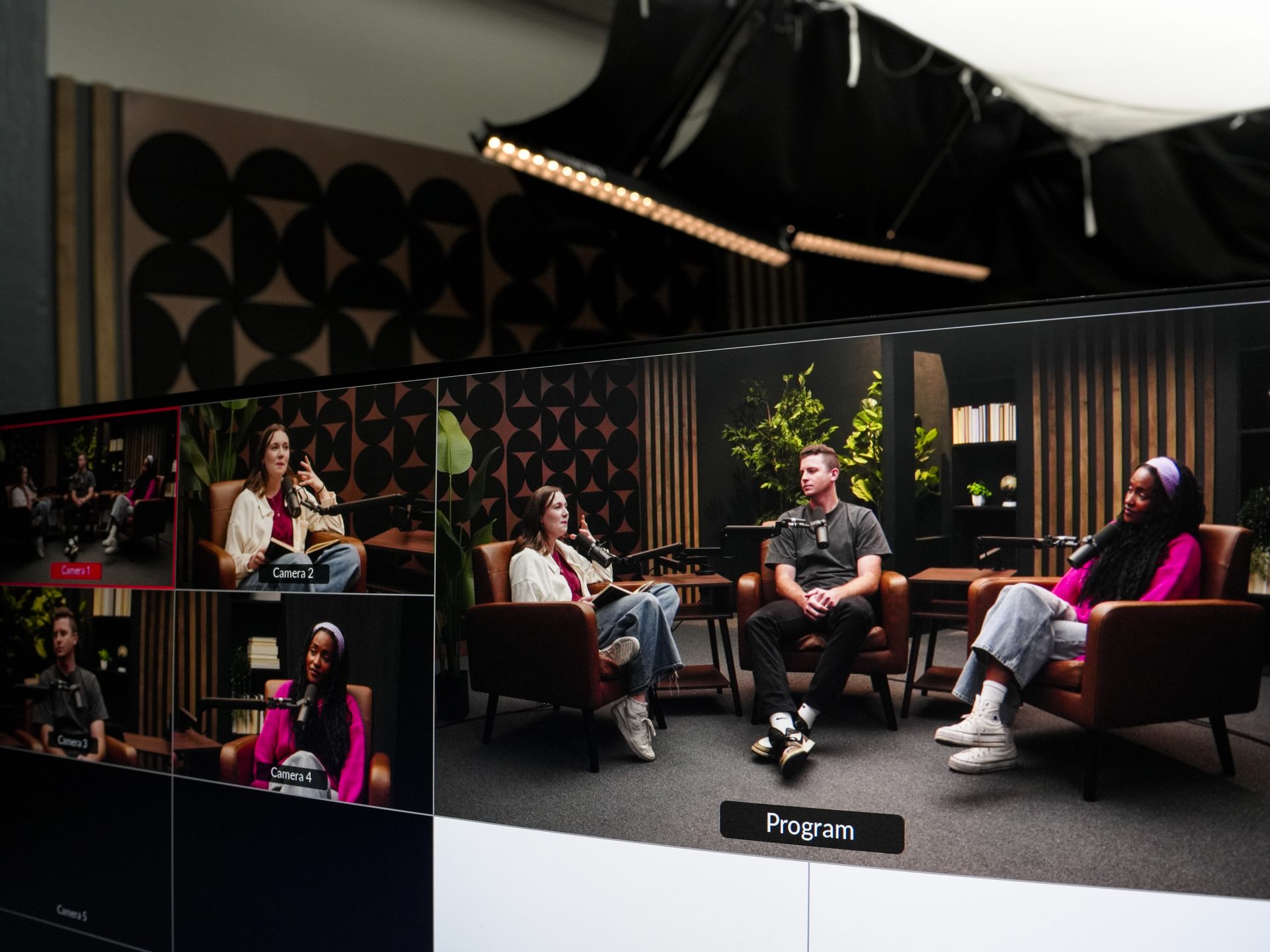
But video-first production collapses both workflows into one. When you record on camera in a professional studio, the video is your master asset. Strip the audio and you have a podcast episode. Clip the highlights and you have short-form social content. Transcribe it and you have a blog post and email newsletter. One session. Multiple outputs.
The real question isn't which format to choose. It's whether you can show up consistently — and whether your production setup makes that sustainable. Our consulting and strategy work starts here, before we ever talk about mics or cameras.
The Case for Starting a Podcast
Audio-first podcasting still has a strong use case, and there are real reasons to start there.
Podcast listeners are passive and loyal. People consume podcasts during commutes, workouts, and chores — situations where video is impossible. That passive listening window is valuable real estate for building authority with a busy audience that doesn't sit in front of screens all day.
Long-form audio also builds trust differently than video. An hour-long interview develops familiarity that a two-minute clip can't replicate. Guests who are camera-shy will often agree to audio-only, which expands your potential guest pool significantly.
If your target audience is primarily listening (not watching) — think executives in transit, professionals managing high meeting loads — an audio-first strategy can be a deliberate, smart choice. The Cincinnati Business Podcast is a clear example of what consistent long-form audio authority looks like in the regional market.
The limitation: once you record audio-only, you've permanently lost the video asset. You can't go back and add a visual layer. That's the tradeoff.
The Case for Making Videos
Video is the dominant content format for B2B decision-makers right now, and the data supports leaning into it hard.
LinkedIn video consistently outperforms text posts in reach and engagement. YouTube is the second-largest search engine in the world and gives your content a long shelf life — a well-optimized video can drive traffic for years. And short-form video on LinkedIn, Instagram, and YouTube Shorts is one of the most efficient ways to reach new audiences without a paid advertising budget.
Beyond distribution, video does something audio can't: it shows the room. Your environment, your body language, your confidence in front of a camera all contribute to how a prospective client perceives your credibility. A business leader who appears on a professionally lit, well-produced video signal looks different than one who doesn't show up visually at all.
Our short-form video production work exists specifically for this reason — to help business leaders pull clips from longer sessions and maintain a consistent social presence without doing double the work.
The Smartest Move: Do Both From One Session
The strategy that consistently delivers the highest content ROI is video-first production — recording on camera and treating video as the master asset that everything else is derived from.
Here's how it works in practice at our video podcast studio in Cincinnati:
- Record a 60-90 minute interview or solo episode on camera. 4K video, professional audio, studio lighting — no gear required on your end.
- Strip the audio track for your podcast feed. Upload to your host (Spotify for Podcasters, Buzzsprout, wherever you publish) and it becomes a standard podcast episode.
- Publish the full video to YouTube. Long-form video content builds SEO authority and gives YouTube's algorithm something to work with over time.
- Pull 6-12 short clips for social media. Vertical cuts for LinkedIn, Instagram Reels, and YouTube Shorts. Horizontal cuts for LinkedIn feed posts and YouTube.
- Transcribe for blog and email. Your recording becomes the source material for written content without starting from scratch.
One session. Thirty-plus pieces of content. The Presence System we've built at CPS is designed exactly for this workflow — making consistent content output predictable instead of exhausting.
How to Decide Based on Your Specific Situation
Not every organization is ready to jump straight to full video-first production. Here's a practical framework for thinking through your situation:
If your audience is executives or enterprise buyers: Video adds credibility that audio alone can't deliver. Being visible on screen is a form of social proof. Go video-first.
If your guests are camera-shy or hard to schedule: Start with audio. Reduce the barrier to saying yes. You can always upgrade to video as your guest relationships develop.
If you have limited internal bandwidth: Batch recording is the answer. Two to four studio sessions per quarter, planned and batched, can generate enough content to publish consistently every week without the team burning out. Our Discovery Call process is built around mapping your bandwidth before recommending a format or cadence.
If you're starting from scratch: Start with video. Choosing audio-only because it feels simpler usually means choosing a format with fewer distribution options and no visual asset. The learning curve for video is front-loaded — it flattens quickly.
If you're in the Cincinnati/NKY market: Your B2B buyers are watching LinkedIn video and YouTube. Your competitors largely aren't producing either consistently. That gap is an opportunity, not a reason to wait.
If you want a clearer picture of what format fits your goals, our podcast idea research process is the right starting point — it validates format, audience, and topic before you invest in production.
What to Watch Out For
A few common mistakes we see when leaders are working through this decision:
Choosing audio-only because it feels less intimidating. Camera anxiety is real, but it fades faster than most people expect. More importantly, choosing audio-only because you're nervous on camera means permanently opting out of the video asset. That's a decision worth reconsidering.
Running separate workflows for each format. If you're producing a podcast and a video channel as two distinct operations with separate recording sessions, editing pipelines, and publishing workflows, you're doubling your workload unnecessarily. One session, derived outputs.
Waiting until the setup is perfect. The gear question is a distraction. A professional studio solves lighting, acoustics, camera, and audio in one move. You don't need to own anything to produce broadcast-quality content — you need a consistent schedule and a space that handles the technical variables.
Publishing inconsistently. Format matters less than consistency. A mediocre podcast that publishes every week beats a polished podcast that publishes whenever someone finds the time. Build a workflow that removes friction first, then optimize quality.
Frequently Asked Questions
Is a podcast or YouTube better for business?
Both have strong use cases. YouTube drives long-term search traffic and visual authority. Podcasts build deep loyalty and are easier to consume passively. A video podcast gives you both — publish to YouTube and strip audio for your podcast feed from one recording session.
Do I need to be on camera for a podcast?
No — but being on camera makes your content more versatile. Audio-only podcasts work well, but video gives you LinkedIn clips, YouTube presence, and social proof that audio simply can't produce.
What's the most cost-effective way to do both a podcast and video?
Rent a professional studio by the session instead of buying equipment. You get broadcast-quality video and audio without the capital investment, and the studio handles setup, lighting, and monitoring. Our studio rental options are built for exactly this use case.
How many pieces of content can I get from one recording session?
A typical 60-90 minute video podcast session at CPS can produce one full-length episode, 6-12 short-form clips, a blog post, an email, and multiple social media graphics — all from the same shoot.
Should I start a podcast if I've never made video content before?
Starting with video-first is actually easier for beginners than most people expect — you have a guest on screen with you, the conversation flows naturally, and you capture your best asset (video) from day one. Audio-only is not simpler; it's just different.
How do I know if a podcast is worth it for my business?
A podcast works best when you have a clear target audience, a consistent guest or solo format, and the patience to publish for 3-6 months before seeing results. Use our podcast idea research process to validate before you invest in production.
The Bottom Line
Podcast versus video is the wrong question. The right question is: what content format can your team show up for consistently, and does your production setup make that sustainable?
For most B2B leaders, video-first is the answer — not because it's harder, but because it's more versatile. One session produces audio, video, and short-form content without duplicating the effort. If you're in the Cincinnati or Northern Kentucky market, the audience is already watching. The gap is in consistent, professional production.
If you're ready to stop debating format and start building a repeatable content engine, let's talk. Book a Discovery Call and we'll map out the right approach for your goals, your team, and your schedule.
Or if you want to start smaller, our podcast idea research is the fastest way to validate whether a show makes sense for your business before you commit to production. Either way, contact the CPS team and we'll point you in the right direction.
Cincinnati Podcast Studio works with B2B leaders across Greater Cincinnati and Northern Kentucky to produce video podcasts, short-form content, webinars, and online courses. Learn more about CPS and how we help organizations build authority through consistent, professional content.