How to Record Content Without Buying Equipment
How to Record Professional Content Without Buying Any Equipment
Most business leaders assume they need to invest in cameras, lighting rigs, acoustic panels, and audio gear before they can produce professional content. That assumption costs teams months of delay — and often tens of thousands of dollars — before a single episode goes live.
The straightforward alternative: rent a fully equipped studio, show up, and record. No gear to buy. No crew to hire. No setup headaches.
Professional-quality content doesn't require owning professional equipment. It requires access to it — and a studio rental gives you that access on demand, for a fraction of the capital cost.
Quick Answer
You can record professional-quality video, podcast, and course content without owning any equipment by renting a fully equipped studio. For a flat session fee, you get 4K cameras, broadcast lighting, professional microphones, and a sound-treated room — plus a production team to handle all the technical setup. You show up, deliver your content, and leave with polished footage ready for editing and distribution.
The Hidden Cost of Building Your Own Home Studio
Before we talk about what studio rental gives you, it's worth understanding what buying your own setup actually costs — because most business owners underestimate it significantly.
A basic professional home studio that can produce content you'd be proud to publish requires:
- Camera system: A capable mirrorless or cinema-grade camera with lens, mount, and HDMI capture card typically runs $3,000–$10,000 for a single-camera setup. Multi-camera adds more.
- Lighting: A proper three-point broadcast lighting kit with stands, diffusers, and power management runs $1,000–$5,000. Cheap lighting is the fastest way to make expensive content look amateur.
- Audio: A quality microphone, preamp or audio interface, cables, and shock mount adds $500–$2,000. Audio quality matters more than video quality to most viewers.
- Acoustic treatment: Panels, bass traps, and diffusers to control room reflections run $500–$3,000, and this assumes a room with favorable geometry to begin with.
- Ongoing costs: Software subscriptions, cable replacements, firmware updates, and the time required to learn and maintain the system.
You're looking at a $5,000–$20,000 starting investment before you record your first episode — and that doesn't include hiring an editor or learning to operate the gear yourself.
For most businesses producing content one to four times per month, that capital never pays off. A studio rental gives you all of it, without owning any of it.
What a Professional Studio Rental Actually Includes
When you book a session at a studio rental options at Cincinnati Podcast Studio, you're not just paying for a room. You're getting a complete production environment that takes years to build and maintain.
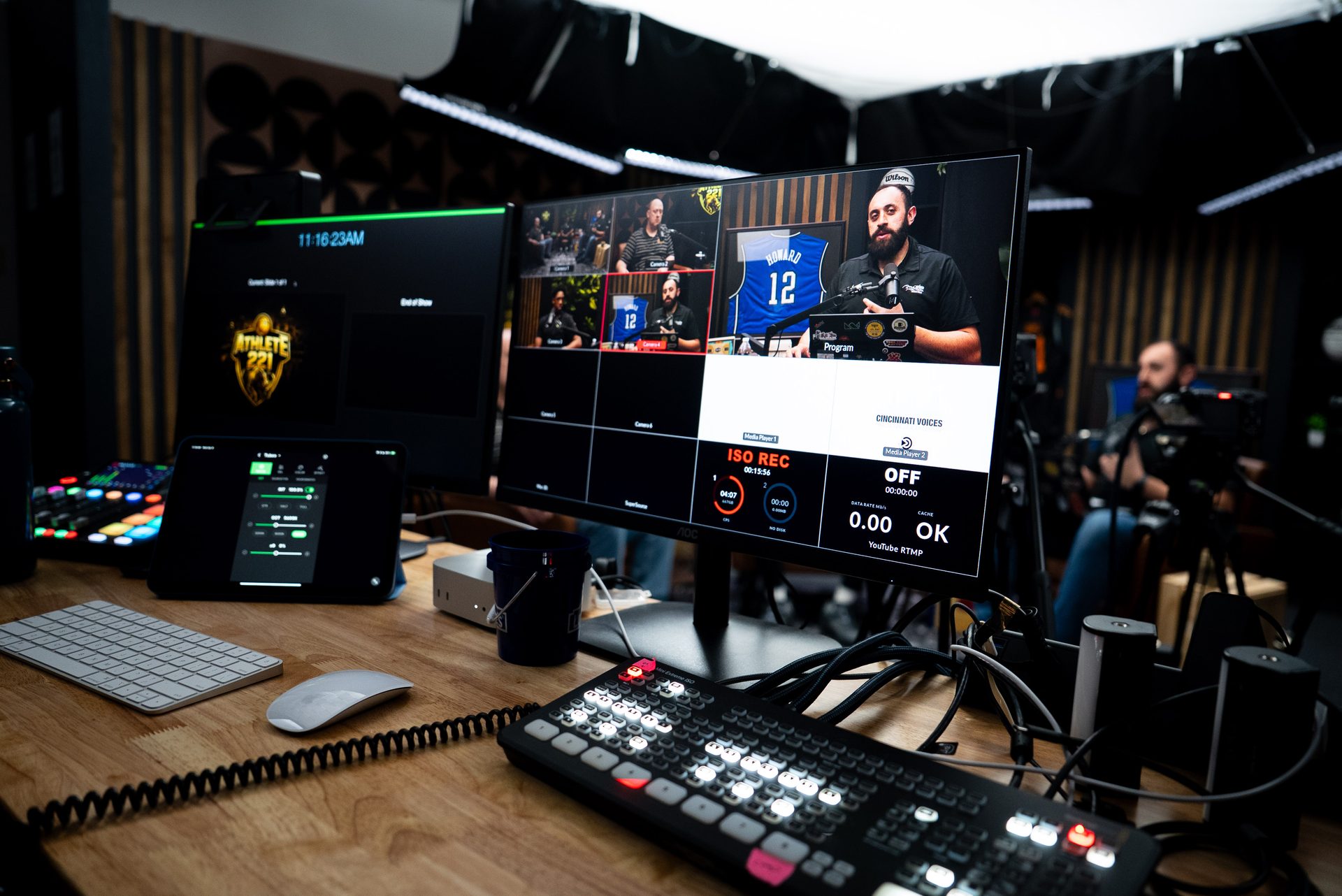
A fully equipped professional studio like CPS includes:
- 4K multi-camera setup: Multiple camera angles captured simultaneously so your editor has real options — not just one static shot.
- Broadcast-grade lighting: Dialed in for your skin tone, studio layout, and the format you're recording. No shadows, no hot spots, no flickering.
- Professional microphones: Condenser and dynamic options depending on your content type, plus properly treated acoustic space to eliminate room noise.
- Sound-treated recording environment: The room itself is engineered for clean audio. Your home office is not.
- A production operator: Someone who handles all the technical decisions so you can focus entirely on what you're saying.
For teams building a video podcast production workflow, the operational lift of managing all of this in-house is significant. Studio rental offloads it entirely.
If you're in Greater Cincinnati or Northern Kentucky and you want to see the setup before you book, book a Discovery Call — we'll walk you through the studio and match the session format to your content goals.
The Best Content Types to Record in a Rented Studio
Studio rental works for more content formats than most people realize. The same session can produce multiple output types, which is one of the reasons batch recording has become a standard workflow for the most efficient content operations.
The highest-value formats to capture in a professional studio:
- Video podcast episodes: The flagship use case. Multi-camera capture, professional audio, and a polished set produce episodes that build credibility with every view. Video podcast production is the core of what we do at CPS.
- Online course modules: Slide-driven or camera-forward, course content demands clean audio and professional-looking video. One studio day can produce an entire module series. See how online course creation works in a dedicated studio environment.
- Webinar recordings: Whether you're recording a live webinar or producing a pre-recorded version, a studio gives you the production quality that keeps viewers engaged. Learn more about webinar production at CPS.
- Short-form social clips: Every long-form recording session generates natural clip material. Our team captures footage designed to be cut into 60–90 second short-form video assets for LinkedIn, Instagram, and YouTube Shorts.
- Thought leadership interviews: Hosting a guest? The studio provides a polished, professional environment that puts both host and guest at ease — and produces footage that reflects your brand.
The Cincinnati Business Podcast is a good example of what consistent, studio-recorded content looks like when produced on a repeatable schedule.
How to Batch Record and Get Maximum Output from One Studio Day
The businesses that get the most from a studio rental are the ones that plan for batch production. Rather than booking a studio for one episode, they block a half day or full day and produce months of content in a single session.
Here's how the most efficient teams approach it:
- Outline topics in advance. Have talking points or loose scripts ready for each segment before you arrive. Studio time is expensive; prep time is not.
- Group similar formats together. Record all podcast episodes first, then shift to course modules, then close with short-form segments. Changing formats mid-session costs time.
- Use a run-of-show. A simple one-page document with segment titles, timing estimates, and order of operations keeps the session on track and the production team aligned.
- Plan your clips at the outline stage. If you know you want three LinkedIn clips from a 45-minute episode, flag those moments before you record. It makes editing far faster.
- Book more time than you think you need. The first session almost always runs longer than expected. Buffer time is not wasted — it's used for pickups and transitions.
If you're not sure how to structure a batch recording day, our consulting and content strategy team can help you build a session plan around your content goals and audience before you ever step in the studio.
Is Studio Rental the Right Move for Your Business?
Studio rental is a strong fit for most B2B teams producing content monthly or quarterly — but it's not the right call for every situation. Here's a practical breakdown.
Studio rental is a strong fit if you:
- Produce video, podcast, or course content one to four times per month
- Don't have a dedicated production space or crew on staff
- Want professional output without a capital equipment investment
- Value the ability to batch-record multiple content types in a single session
- Are building authority and trust through consistent content — not chasing viral moments
It may not be the right fit if you:
- Need a live broadcast studio available seven days a week at any hour
- Have already built an in-house studio that meets your quality bar
- Are producing daily, casual, low-stakes content where production value isn't a differentiator
If you're a business leader in Cincinnati or Northern Kentucky who's been putting off content production because the setup feels too complicated or expensive, studio rental removes both objections at once.
The gear is already there. The crew is already there. You just have to show up.
Frequently Asked Questions
How much does it cost to rent a video or podcast studio?
Rental rates vary by session type and services included. Book a Discovery Call with the CPS team to learn what's available and what fits your content goals.
Do I need to bring my own equipment to a studio rental?
No. A fully equipped studio like CPS provides cameras, microphones, lighting, and the production setup. You bring yourself and your talking points.
Can I record multiple types of content in one studio session?
Yes — and most clients do. Podcast episodes, short-form social clips, and course segments can all be captured in a single day. Batching maximizes every hour you're in the studio.
Is renting a studio more cost-effective than buying my own gear?
For most businesses producing content monthly or quarterly, rental is significantly more cost-effective than buying, maintaining, and learning professional equipment.
Do I need production experience to use a professional studio?
None required. The production crew handles all technical setup, framing, and capture. You focus entirely on delivering your content.
Where can I rent a professional video and podcast studio in Cincinnati?
Cincinnati Podcast Studio at 1776 Mentor Ave offers fully equipped studio rentals for video podcasts, course recordings, webinars, and short-form content — serving the Greater Cincinnati and Northern Kentucky area.
If you've been waiting on a studio setup to start producing content, you don't have to wait anymore. The equipment, the crew, and the space are already in place. The only thing left is to decide what you want to record first.
Book a Discovery Call to talk through your content goals and see if a studio rental session is the right next step. Or contact the CPS team with any questions — we'll help you figure out the right format and session structure before you commit to anything.