How Many People Can Record in a Studio at Once?
How Many People Can Record in a Studio at Once?
One of the most common questions we get before a first session: can I bring someone with me? Whether you're planning a podcast interview, a panel discussion, or a multi-speaker webinar, the answer matters before you book. At Cincinnati Podcast Studio, the setup is built for group recording — not just tolerates it.
Here's what multi-person sessions actually look like at CPS, what to expect from the production side, and how to get the most out of a group recording day.
Quick Answer: How Many People Can Record in a Studio at Once?
At Cincinnati Podcast Studio, up to 4 people can record on camera at the same time in a single session. The studio is built for multi-person formats — podcast interviews, panel discussions, webinars, and course recordings. Every seat gets a dedicated microphone and camera angle, so group sessions produce broadcast-quality footage without technical compromise.
How Many People Can Record at CPS?
The studio comfortably seats and records up to 4 people on camera simultaneously. That's not a soft ceiling — it's an engineered one. The set is staged and lit to support multi-person framing, and the signal chain is built to handle individual audio per person without bleed, background noise, or the coverage gaps you get from room mics or a single condenser.
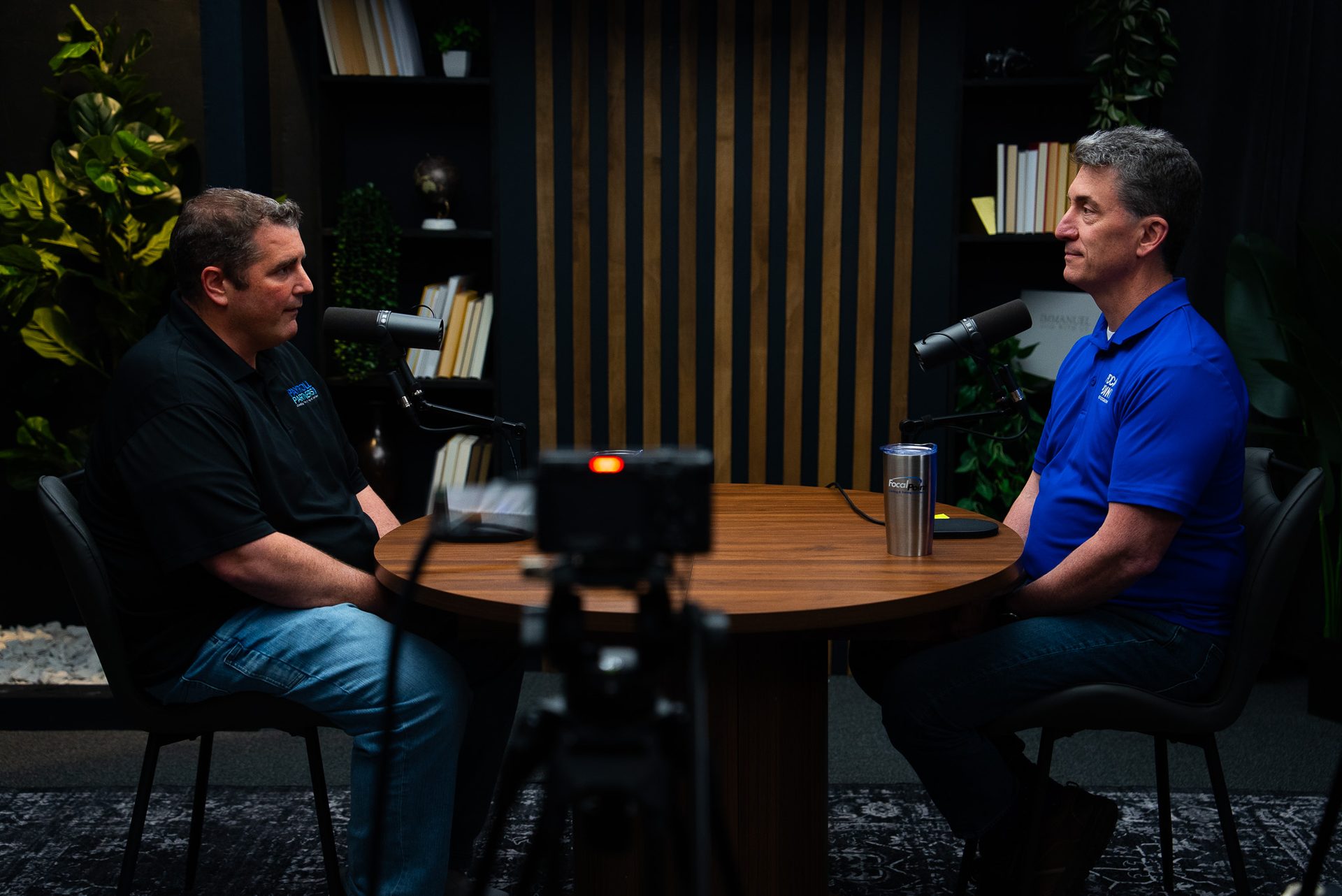
Every person in the room gets their own dedicated microphone and a dedicated camera angle. That means you end up with clean, isolated audio per speaker and professional footage for each seat — not a compromise where one camera tries to cover everyone while the audio blurs together.
For most video podcasting and webinar production formats, 2-4 people is the ideal range. Solo sessions work, too — the studio adapts either way.
What Determines Studio Capacity?
Capacity in a professional studio isn't just about how many chairs fit. It comes down to three things: camera positions, microphone infrastructure, and set staging.
Camera Positions and Framing
Every seat needs a clean angle that frames the speaker well — not a wide shot where everyone looks small, and not a compromise where some guests are partially off-frame. At CPS, the set is designed so each seat gets its own primary angle. Group framing (a wide "beauty shot" of the full table) is also captured as a secondary angle for cutaways and intros.
Microphone Count and Signal Chain
Shared microphones are one of the fastest ways to degrade audio quality in a group session. When two or three speakers share a mic, you get off-axis sound, inconsistent levels, and audio that's harder to edit. At CPS, every seat has its own dedicated broadcast-grade microphone, captured on separate tracks. That gives the editor clean, isolatable audio per person — which matters for post-production, clip creation, and transcription accuracy.
Set Size and Staging Logistics
A studio set has physical limits. The table, seating, lighting rigs, and monitor placements all affect how well a group session actually looks and sounds on camera. CPS is built to handle up to 4 people without staging workarounds. Beyond 4, the framing, audio, and set design would require compromises — which is why 4 is the practical ceiling, not a soft guideline.
If you're planning a larger production — a panel event, a live studio audience recording, or a multi-location shoot — that's a different conversation. Reach out via Discovery Call and we can talk through what that would involve.
Multi-Person Recording Formats That Work Well in a Studio
The number of people in the room shapes the format — and different formats have different strengths. Here's how the most common multi-person setups work at CPS.
Two-Person Podcast Interview
The most common format. A host and a single guest sit across from each other, each with their own mic and primary camera angle. This is the standard setup for most business podcasts and interview-based shows. Clean audio, easy to edit, and the footage cuts into short-form clips without extra effort.
If you're launching a podcast or testing a new interview format, this is the natural starting point. Learn more about what a professional video podcast session includes.
Three-Person Roundtable or Panel
Three people works well for panel discussions, co-hosted shows, or episodes where you want a moderator plus two guests. The staging creates a natural dynamic — center moderator, two guests flanking — and the footage gives the editor more variety to work with for both long-form and short-form video clips.
Four-Person Executive Podcast or Advisory Discussion
Four is the maximum at CPS, and it works best for formats where the conversation benefits from multiple voices — an executive round table, a leadership team discussion, or an advisory board episode. The production team manages the technical side so the group can focus on the conversation.
Multi-Speaker Webinar or Training Recording
Group sessions also work well for webinar production and course creation with co-instructors or subject matter experts. The dedicated audio-per-speaker setup is especially valuable here — training content needs clean, isolatable audio for editing, captioning, and LMS integration.
How to Prepare for a Group Recording Session
Multi-person sessions have more moving parts than solo recording. A little prep work on the front end makes the session run faster and the content better.
Brief Each Guest in Advance
Share a short overview of the topic, any questions you plan to cover, and a wardrobe note (avoid busy patterns, all-white, or all-black). Guests who arrive prepared talk more naturally on camera — especially if it's their first time in a studio.
Build a Run-of-Show
Even a rough outline helps. Knowing the segment order, approximate time per topic, and planned transitions keeps the session on track and makes it easier to batch multiple episodes or topics in a single day. The CPS production team will work through it with you, but arriving with something in hand speeds everything up.
Coordinate Arrival Timing
When multiple people are recording, staggered arrivals create gaps. If the session is batching multiple conversations, plan for the first group to be ready to record at the session start time — not arriving at it.
Batch Multiple Conversations in One Day
One of the real advantages of group recording at a professional studio: you can batch multiple interviews or panel discussions in a single day. Many CPS clients record 2-4 separate conversations in one session, producing a month or more of content before they leave. That's the core of the content engine model — one production day, weeks of output.
If you're in Greater Cincinnati or Northern Kentucky, a single batch session can cover your content calendar for a quarter. That's not hype — it's math.
Common Mistakes When Recording With Multiple People
Group sessions surface a few predictable problems. Most are easy to avoid if you know what to watch for.
Skipping the Guest Brief
Guests who don't know what to expect tend to be stiff on camera for the first 10 minutes. A quick pre-session email with the topic list, wardrobe note, and arrival instructions fixes 80% of that.
Overcrowding the Format
Four people is the functional limit for a reason. Groups larger than that rarely produce better content — they produce more crosstalk, harder-to-follow conversations, and footage that's difficult to edit into clean clips. If you have a large team that needs content, batching smaller groups across multiple conversations usually produces more usable output.
Arriving Without a Plan
The production team at CPS can help shape a session on the fly, but groups that arrive with no run-of-show tend to spend the first 20-30 minutes figuring out what they're doing. That's time you paid for. A rough outline — even a list of 5 questions — makes a significant difference.
Treating the Studio Like a Conference Room
A professional recording session is a production, not a meeting. That means it benefits from a bit of structure: clear roles (who's the host, who's the guest), an agreed-upon topic flow, and trust that the production team will handle the technical side. Your job is to have the conversation. Everything else is handled.
Before your group session, review podcast idea research if you're still developing the format, or reach out to the team via contact page if you have questions about what's possible for your group size and format.
Frequently Asked Questions
How many people can record in a studio at once at CPS?
Up to 4 people can record on camera simultaneously at Cincinnati Podcast Studio. Every seat includes a dedicated microphone and camera angle for broadcast-quality multi-person footage.
Can I bring a guest to my podcast recording session?
Yes. CPS is designed for multi-person recording. Guests can sit across from you for an interview format, or join a roundtable-style panel — up to 4 people total on camera at once.
Do I need to pay more for group recording sessions?
Session pricing is based on the service tier you select, not the number of people in the room. Book a Discovery Call and we'll walk through what's included for your format.
What formats work for group studio recording?
Podcast interviews (2-person), roundtable panels (3-4 person), executive discussions, webinars with multiple speakers, and course recordings with a co-instructor all work well in the CPS studio.
Can remote guests join a group recording session?
Yes. CPS can accommodate hybrid formats where one or more participants join remotely while in-studio guests record with full broadcast-quality audio and video.
How do I prepare my guests for a group recording session?
Share a brief outline of topics, confirm arrival time, and give a simple wardrobe note (avoid bright patterns or all-white). The CPS production team handles the rest — mics, camera framing, and session flow.
Ready to Book a Group Session?
Whether you're bringing one guest or a full panel of four, CPS is built to make multi-person recording straightforward. Every seat is set up for broadcast-quality audio and video — no workarounds, no compromises.
The Cincinnati Business Podcast is a good example of what a well-produced multi-person format looks like in practice. Take a look at what comes out of a single production day.
When you're ready to book a group session or talk through your format, schedule a Discovery Call. We'll walk through your recording goals, how many people you're bringing, and what you want to walk out with. From there, we handle the rest.
Looking for more on studio capabilities? Explore the CPS resources hub or check out the about page to see how the studio works.