
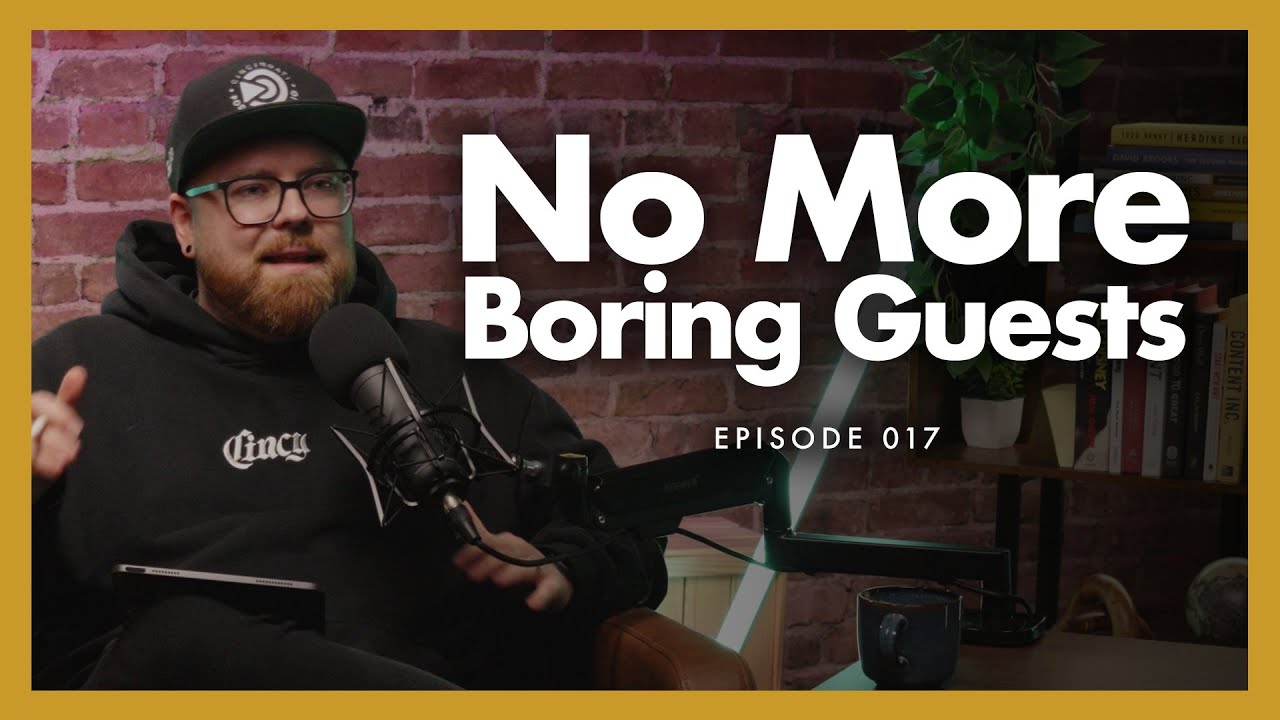
How to Vet Podcast Guests and Avoid Boring Interviews
What to Do When Your Podcast Guest Is Boring (Pre-Interview Vetting Secrets)
You've done everything right. Booked a guest with strong credentials, prepped your questions, set up the mics. Then the interview starts and you realize within the first five minutes: this person is not a good podcast guest. They give one-word answers. They speak in corporate jargon. Every story gets sucked into a black hole of vague generalities.
It happens to every podcast host eventually. But it doesn't have to be a recurring problem. The fix starts long before you hit record — and that's exactly what we cover in this week's episode.
Pre-interview vetting isn't gatekeeping. It's quality control for your audience.
Quick Answer: How Do You Avoid Booking a Boring Podcast Guest?
The best way to avoid a boring podcast guest is to vet them before you book. Review their existing media appearances, run a 10-15 minute pre-interview call, and ask at least one question that requires a real, specific answer — not a rehearsed elevator pitch. Assess how they communicate under light pressure. If someone struggles to tell a story in a relaxed pre-call, they will struggle on camera too. Vetting is a gift to your audience.
Why Even Credentialed Guests Fall Flat
An impressive LinkedIn profile and a strong guest pitch do not guarantee a compelling interview. Many high-achieving professionals are excellent at their jobs and genuinely difficult to listen to for thirty minutes.
There are a few common reasons credentialed guests disappoint:
- They're interview-averse. Some people have never been interviewed before and freeze under the pressure of a microphone.
- They're overly polished in the wrong way. A guest who has only done pitch calls or formal presentations will default to boardroom mode — technically accurate, emotionally flat.
- They don't have a strong point of view. A guest who refuses to take a stand on anything produces forgettable content every time.
- They won't share specifics. Vague answers kill momentum. "We grew the business" is not a story. "We grew 40% after cutting half our service lines" is.
None of this is the guest's fault. It's a systems problem — and a solvable one. If you want to produce a professional video podcast that holds an audience's attention, you need a vetting system, not just good intentions.
The Pre-Interview Vetting Process: A Step-by-Step Playbook
Step 1: Review Their Existing Media Footprint
Before you ever get on a pre-call, do 15 minutes of homework. Search for any podcast appearances, conference talks, webinars, or interviews your prospective guest has done. Watch or listen to at least 5-10 minutes.
What you're evaluating:
- Do they speak in complete, interesting sentences?
- Do they tell specific stories, or do they stay at 30,000 feet?
- Do they have a clear perspective, or do they hedge everything?
- Are they easy to follow, or do they ramble?
If you can't find any prior media appearances, that's not automatically disqualifying — but it does mean the pre-call matters even more.
Step 2: The 15-Minute Pre-Interview Call
The pre-call is your most valuable vetting tool. It's not a full run-through. It's a structured conversation designed to reveal how this person actually communicates when they're relaxed and not reading from a script.
Keep it short: 15 minutes max. Cover:
- A brief overview of your show and audience
- What topics you're planning to cover with them
- One or two open-ended questions (see Step 3)
- Logistics: date, time, location or platform, any prep they should do
Pay attention to the energy of the call, not just the content. Are they engaged? Do they ask questions back? Are they present, or are they multitasking? The way someone shows up on a 15-minute pre-call is a reliable preview of how they'll show up on a 45-minute recorded interview.
Step 3: Test Their Storytelling Instinct
Ask one question that requires a specific, experience-based answer. Not "Tell me about your company." Something like:
- "What's one decision you made in the last year that you initially thought was a mistake but turned out to be the right call?"
- "Can you walk me through a specific moment when your approach to [topic] completely changed?"
- "What's something you believe about [industry] that most people in your field would push back on?"
A guest who answers this kind of question with a specific, honest story is almost always a good interview. A guest who responds with generic talking points is flagging a potential problem.
Step 4: Watch for Red Flags
Hard passes — or at minimum, a conversation about adjusting your format:
- They want to review and approve your questions in advance (signals control issues; will kill spontaneity)
- They ask to see the edit before it publishes without a prior agreement
- They have a strict promotional agenda and can't be moved off it
- They give the same three-sentence answer to every question in the pre-call
- They're late to, or reschedule, the pre-call with no warning
These behaviors rarely improve when a camera is on. Set expectations early — or reassess whether this is the right guest for your show.
How to Prep Your Guests So They Show Up Ready
Even great communicators benefit from a little structure. Once a guest is confirmed, send them a simple one-page prep document that includes:
- A description of your show and the audience they'll be speaking to
- Two or three themes or questions you plan to explore (not the full list)
- A note about format: length, whether it's video, how it will be distributed
- One piece of practical advice: "Come ready to share a specific story or example — your audience will connect with concrete details more than general advice"
This serves two purposes: it reduces guest anxiety (which produces better conversations) and it signals that your show is professional and worth their best effort. If you're doing short-form video clips from the episode, let them know — most guests appreciate knowing the content will extend beyond the full episode.
What Happens When You Skip Vetting
Beyond a dull episode, there are real operational costs to a bad guest booking:
- Editing time multiplies. A meandering interview that needs heavy cutting takes significantly longer to produce than a tight, well-paced one.
- Clips don't work. Short-form social clips depend on punchy, quotable moments. A flat interview doesn't produce them.
- Your audience's trust erodes — slowly. One boring episode isn't fatal. A pattern of them signals that your curation standards are low.
- The guest is also poorly served. A bad interview is a bad experience for everyone in the room.
If you're working with a podcast consultant or a full-service production team, vetting should be part of the documented workflow — not an afterthought.
How We Handle Guest Quality at Cincinnati Podcast Studio
At Cincinnati Podcast Studio, we work with business owners and marketing teams who produce ongoing shows from our studio. Guest quality is one of the first things we build into a client's system.
That means creating a repeatable intake process: a standardized booking form, a pre-interview call template, and a guest prep document tailored to each show. We've seen firsthand how this changes the quality of every episode downstream — tighter conversations, better clips, and audiences that keep coming back.
If you're based in Cincinnati or Northern Kentucky and you're building a video podcast that needs to perform as a business asset — not just a content bucket — a structured guest process is one of the highest-leverage things you can put in place. It's a core piece of what we walk clients through on a Discovery Call.
For a deeper look at how we approach podcast strategy, check out the Cincinnati Business Podcast — real conversations with B2B leaders in the region, built around the same principles we teach.
And if you're still figuring out whether a podcast is right for your business, our Podcast Idea Research service is a practical starting point. We validate the concept and build the foundation before you commit to production.
Frequently Asked Questions
How do I know if a guest will be boring before I book them?
Review any prior media appearances first — podcast interviews, conference talks, webinars. Then run a 15-minute pre-call and ask at least one question that requires a specific, experience-based answer. How they respond in a low-stakes pre-call is a reliable preview of how they'll perform on camera.
Should I turn down a guest who is boring in the pre-call?
It depends. If they're boring because they're nervous about the pre-call itself, that's different from someone who consistently defaults to corporate-speak with no specifics. If a guest can't give you one compelling story or clear opinion across an entire pre-call, that's a genuine signal. It's fair to either pass or suggest a different format — a shorter segment or a co-hosted panel where they don't have to carry as much of the conversation.
What questions should I ask in a podcast pre-interview call?
Ask one question that requires a specific, personal answer — something about a decision they made, a failure they learned from, or a belief they hold that goes against conventional thinking in their field. Avoid vague openers like "Tell me about yourself." Specific questions reveal how someone actually thinks and communicates.
How far in advance should I run the pre-interview?
At least 3-5 days before the recording date. This gives you time to send a prep document, adjust your question list based on what you learn, and handle any logistics changes without scrambling.
Do I need a pre-interview call for every guest?
For ongoing shows, yes — especially in the early stages. Once you have a reliable intake process and you're booking guests in similar categories, you can streamline it. But skipping it entirely is rarely the right call for a video podcast where the guest's on-camera presence matters.
How do I tell a guest their pitch isn't a fit without burning the relationship?
Keep it straightforward. "We've looked at your background and we think [other show / different format / future episode] would be a better fit" is clear and professional. You don't owe anyone a detailed explanation. Most people respect a direct, respectful answer far more than being ghosted.
Bottom Line
Boring podcast guests are almost always a pre-production problem, not a guest problem. With a clear vetting checklist, a 15-minute pre-call, and a simple guest prep document, you can dramatically improve the consistency and quality of every episode you produce.
If you want a production system that builds this kind of quality control in from day one, we'd like to talk. Book a Discovery Call with our team and we'll walk you through how we approach guest quality, show structure, and the full production workflow for B2B video podcasts in Cincinnati and Northern Kentucky.
More resources for podcast hosts and content teams are available in our Resources hub.