
What Makes a Good Business Podcast (And Why Most Fail)
What Makes a Good Business Podcast — And Why Most Never Get Past Episode 10
Every week, thousands of business leaders launch a podcast with real conviction — and then quietly stop publishing three months later. The gear gets returned, the RSS feed goes cold, and the idea gets filed under "maybe next year." It almost never comes down to effort. It comes down to structure.
After working with B2B companies, consultants, and founders across Cincinnati and Northern Kentucky, we've seen the full pattern — what separates the shows that build real authority from the ones that fizzle out before they find their audience.
The shows that last have three things in common: a clear audience, a consistent point of view, and a system that makes publishing sustainable. Everything else — format, episode length, guest strategy — flows from those three.
Quick Answer: What Separates Good Business Podcasts From the Rest
A good business podcast has a clear audience, a consistent point of view, and professional production quality. The best ones treat each episode like a business asset — not a hobby. Consistency, credibility, and a reason to listen keep audiences coming back and turn listeners into buyers. Most podcasts that fail do so not because of bad content, but because the workflow wasn't built to survive past the launch energy.
Start With a Clear Audience and a Specific Point of View
The most common mistake we see isn't bad audio — it's a show that exists for everyone, which means it connects with no one. Before you decide what to talk about, decide who you're talking to. Not "business professionals." A specific person with a specific problem in a specific industry.
That clarity changes everything. It shapes your episode topics, your guest list, your CTA, and the language you use. When a listener hears your show and thinks "this is made for me," you've won the most important battle in podcasting: getting them to episode two.
Your point of view is what makes the show worth subscribing to. Anyone can aggregate information. What listeners come back for is editorial judgment — your take, your framework, your interpretation of what's happening in the industry. That's what creates a brand, not just a show.
If you're interviewing guests without weaving in your own perspective, you have a collection of conversations, not a podcast. Add editorial context. Open with your angle. Close with your synthesis. Make the audience feel like they're hearing something they can't get anywhere else.
Narrow your focus early. The counterintuitive truth about podcasting is that a tighter niche builds faster than a broad one. When you serve a narrow audience well, word of mouth spreads within that community. When you try to appeal to everyone, you become background noise. Our Podcast Idea Research process helps business leaders clarify this before they record a single episode.
Production Quality Signals Credibility Before You Say a Word
Listeners form an impression in the first 15 seconds. If the audio is muddy, the background noise is distracting, or the video looks like it was recorded in a parking garage, they're gone — and they're not coming back. That first impression isn't about perfection; it's about signaling that you take this seriously.
Poor production quality is a credibility tax. It makes your audience work harder to trust you, and in B2B content, trust is the entire game. Your podcast is often the first extended conversation a potential client has with your brand. What they see and hear tells them how you operate.
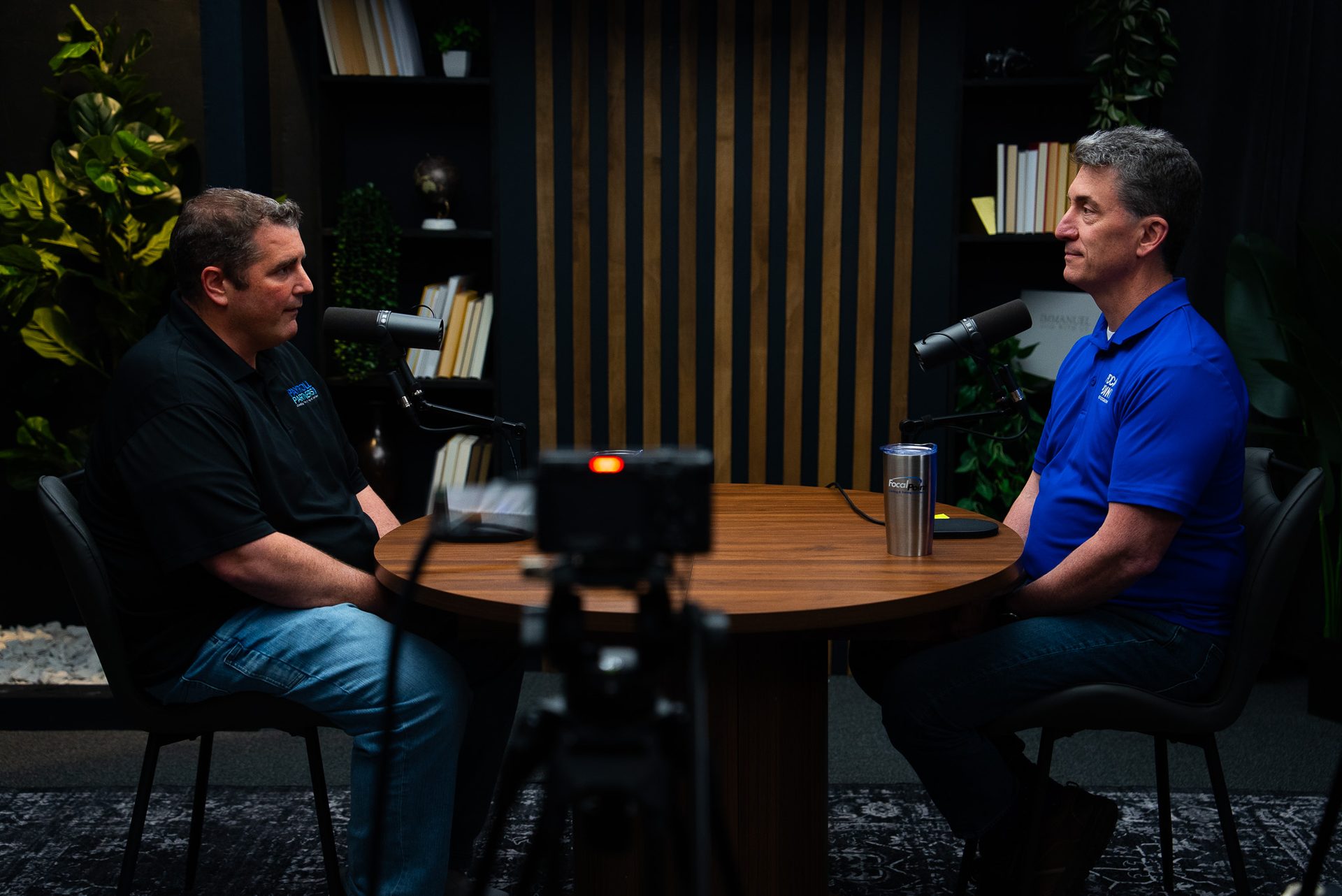
Video podcasting has raised the bar significantly. A well-lit, professionally filmed conversation communicates competence before a word is spoken. The visual layer reinforces the audio — and it gives you a distribution advantage. A recorded video interview becomes a YouTube video, a LinkedIn post, and a dozen short clips. The same content, multiplied.
You don't need to own equipment to sound and look professional. Most business leaders record in a studio rental where the gear is already set up, tested, and calibrated. The time you'd spend troubleshooting your home setup is better spent preparing for the conversation. Explore our video podcasting services to see how most CPS clients handle this.
If you're recording in Cincinnati or Northern Kentucky, the fastest path to broadcast-quality results isn't buying gear — it's booking studio time. You show up, you talk, and you leave with professional content.
Consistency Is the Strategy Most Business Podcasters Skip
Consistency isn't a nice-to-have — it's the foundational mechanism by which podcasts build audience. When listeners know a new episode drops every Tuesday, they build a habit around your show. When your release schedule is unpredictable, that habit never forms, and you're starting from scratch with each episode.
The stats on podcast attrition are worth understanding: most shows die between episodes five and fifteen. Not because the host runs out of ideas — because the workflow wasn't built to survive the point where launch energy wears off. A system that depends on motivation is a system that will eventually fail.
The solution most serious business podcasters land on is batch recording. Instead of recording one episode per week, you block a half-day at the studio every month and record four or five episodes in sequence. You leave with a buffer. You publish consistently without a weekly deadline. The audience experiences a reliable show; you experience a sustainable workflow.
This is exactly how the Cincinnati Business Podcast and many of our clients structure their production schedules. Batch recording transforms podcasting from a constant obligation into a monthly system — and that's the difference between a show that lasts two years and one that dies in two months.
Bi-weekly is often better than weekly if weekly isn't sustainable. A consistent bi-weekly show will always outperform an erratic weekly one. Set a cadence you can hold to, build a buffer, and protect it.
How to Use Your Podcast to Build Trust and Drive Pipeline
The business case for podcasting isn't about downloads. It's about what happens to a sales conversation after a prospect has listened to six hours of your thinking. They already trust you. They already understand your framework. They're not evaluating whether you know your stuff — they're deciding whether to work with you specifically.
That's the trust accelerator model: your podcast does the relationship-building work at scale, so by the time someone gets on a call, the heavy lifting is already done. Sales cycles get shorter. Objections disappear faster. Clients arrive pre-sold on your approach.
Guest strategy amplifies this. When you invite ideal clients, referral partners, or industry peers onto your show, you're creating a one-to-one relationship at the same time you're creating a one-to-many piece of content. The guest gets exposure; you get a relationship. That single conversation has more pipeline value than most cold outreach campaigns.
Repurposing is where the math gets interesting. A single 30-minute video podcast episode can become: a YouTube video, 6–10 short-form video clips for LinkedIn and Instagram, a blog post, an email, and a set of quote graphics. Our short-form video team handles this extraction process for CPS clients — so the production session generates content across every channel, not just one.
If you're a B2B team in Cincinnati or Northern Kentucky and you're still treating your podcast as a standalone project instead of the cornerstone of your content engine, you're leaving pipeline on the table. Consulting and content strategy sessions are how we help business leaders build a system around what they're already creating.
Common Mistakes Business Podcasters Make (And How to Avoid Them)
Most podcast failures are predictable. The same patterns show up across industries and show types. Understanding them in advance is how you avoid them.
- Launching without a defined listener. "Everyone interested in business" is not an audience. Define the specific person you're serving before you record episode one.
- Recording at home and hoping post-production saves it. Post-production can clean up minor issues. It can't fix a fundamentally bad acoustic environment or inconsistent lighting. Get the source right.
- Publishing irregularly, then going dark. Two weeks without an episode breaks the habit you've been building. Three weeks signals to algorithms and listeners that the show may be inactive. Batch recording is the fix.
- Treating each episode as a standalone piece. The best shows build a narrative arc across episodes. Listeners should feel like they're learning a framework over time, not consuming random content.
- Skipping video. In 2024 and beyond, a podcast without video is leaving its most powerful distribution channel unused. LinkedIn, YouTube, and short-form platforms all favor video. If you're only publishing audio, you're competing with one hand behind your back.
- Never having a clear next step for listeners. Every episode should end with one specific action — a Discovery Call, a resource download, a related episode. Listeners who want to engage need a door to walk through.
FAQs: What Makes a Good Business Podcast
- How long should a business podcast episode be?
- Most B2B podcasts perform well between 20 and 45 minutes. The right length depends on your format and audience, but shorter, focused episodes often outperform rambling long-form content. If you can make the same point in 25 minutes, do it.
- Do I need a video podcast or is audio-only fine?
- Audio-only is still viable, but video podcasting is the fastest-growing format in B2B content. Recording video gives you a YouTube presence, LinkedIn clips, and short-form content — all from the same recording session. If you're starting today, record video.
- How often should a business podcast publish?
- Weekly is the gold standard. Bi-weekly works if you can hold to it. The key is consistency over frequency — a reliable bi-weekly show builds more trust than an unpredictable weekly one. Batch recording is the best system for staying consistent without burning out.
- Should I interview guests or do solo episodes?
- Both work. Guest interviews build relationships with potential referral partners and clients, and they're easier to maintain because the conversation carries itself. Solo episodes build personal authority faster. Most strong business podcasts mix both formats.
- What equipment do I need to start a business podcast?
- If you're recording in a professional studio, the gear is already there. If you're setting up at home, you need a quality USB microphone, proper lighting, and a quiet room. The fastest path to broadcast-quality audio and video is to record in a studio rather than buying equipment you may use once.
- How long does it take to see ROI from a business podcast?
- Most business podcasters see meaningful pipeline impact in six to twelve months of consistent publishing. The ROI accelerates when episodes are repurposed into short-form video, blog content, and email — turning each recording session into a multi-channel content asset.
Build a Podcast That Works as Hard as You Do
A good business podcast isn't the result of buying better gear or hiring a better editor. It's the result of clear strategy, sustainable systems, and a commitment to showing up consistently for the audience you defined before you hit record.
The shows that build real authority — the ones that turn listeners into clients and referral sources — are built on those fundamentals. Everything else is execution detail.
If you're in Cincinnati or Northern Kentucky and you're thinking about launching a business podcast — or relaunching one that stalled — start with a conversation. Our Podcast Idea Research process is how we help business leaders validate their concept, define their audience, and build a publishing system that doesn't collapse under its own weight.
Ready to stop thinking about it and start building it? Schedule a Discovery Call and we'll map out what a sustainable, professional podcast looks like for your business. You can also contact us with questions, or explore our full suite of video podcasting services to see how CPS clients build content engines that work.