
What Content Should My Business Actually Be Creating?
What Content Should My Business Actually Be Creating?
It's one of the most common questions we hear from business owners and marketing leaders: we know we need to create content, but we have no idea where to start — or why what we tried before didn't work. The answer isn't a single format or platform. It's a strategy built around how your buyers actually make decisions.
This guide gives you a clear framework for choosing the right content types, the right cadence, and the right production approach for a B2B business that wants results — not just output.
Quick Answer
The right content for your business is the type that matches how your buyers make decisions. For most B2B companies, that means long-form trust-building content — video podcasts, thought leadership articles, and short clips — distributed consistently. Start with one format you can sustain, build around your expertise, and repurpose from there.
Why Most Businesses Create the Wrong Content
Most companies don't have a content problem. They have a strategy problem dressed up as a content problem. They start creating because they feel like they should, without asking the more important question: what does my buyer need to see before they trust us enough to call?
Three patterns show up repeatedly:
- Chasing trends instead of building authority. Reels, TikToks, and trending formats feel urgent, but they rarely move enterprise or B2B buyers. Your buyer isn't watching dance trends — they're Googling questions and evaluating whether your company seems like the real deal.
- Inconsistent output kills momentum. Three posts in January, then nothing until May, then a burst in Q3. Buyers notice inconsistency. It signals instability, even when the business itself is solid.
- Wrong format for the wrong buying stage. A 15-second clip doesn't close a $50,000 deal. It might start a conversation. But if you're only creating clips, you're missing the content that actually converts — long-form trust builders that educate, validate, and establish credibility.
If your content isn't working, one of these three is almost certainly the cause. The fix isn't more content. It's better-positioned content.
The Three Questions That Clarify Your Content Strategy
Before deciding on formats or platforms, answer these three questions. Everything else flows from them.
1. Who is your buyer and how do they buy?
B2B buyers don't impulse-purchase. They research. They ask colleagues. They evaluate credibility over weeks or months. That means your content needs to be present across that entire decision journey — not just at the top of the funnel where most businesses park everything.
A CEO evaluating a podcast production partner, for example, is going to watch a sample episode before calling. They're going to read two or three blog posts. They may watch a few short clips on LinkedIn. Your content needs to show up at each of those touchpoints with the same consistent message: we know what we're doing, we've done this before, and we're the right fit for you.
2. What do you know that your buyers need to hear?
Your expertise is your content. The questions your clients ask in the first sales call, the mistakes you see prospects making, the frameworks you use to produce results — that's your content calendar. You don't need a content agency to invent topics. You need a production system to capture what your team already knows.
Our video podcast production clients often tell us their best episodes are just conversations they've had dozens of times — finally captured on camera. The expertise was always there. The format made it scalable.
3. What format can you sustain at least monthly?
The best content format is the one you'll actually publish. A daily blog you quit after three weeks is worse than a monthly video podcast you run for three years. Sustainability beats volume every time.
For most B2B businesses, that means anchoring around one high-production-value format — typically a video podcast or a structured webinar series — and repurposing from there. One session produces clips, a blog post, email content, and LinkedIn material. The engine runs from a single recording day, not from constant creation pressure.
If you're not sure what format fits your team's bandwidth, a podcast idea research session is a practical starting point. We help you validate the format, audience, and topic angle before you commit to production.
The Content Formats That Work Best for B2B
Not all content formats are equal for B2B audiences. Here's how the main formats stack up — and what role each plays in a well-built content engine.
Video Podcasts: Trust at Scale
A video podcast is the highest-leverage format for B2B companies that sell based on expertise. It lets you demonstrate how you think, validate your experience, and build a real relationship with a prospect — before they ever contact you. Episodes live forever on YouTube and your website, compounding in value with every new listener.
The Cincinnati Business Podcast is a strong example of this model in action — a show built around local business leaders that builds community authority and generates warm introductions for the studio and its guests.
For companies that sell consulting, professional services, or anything requiring a relationship, a video podcast isn't a nice-to-have. It's one of the most effective prospecting tools you can build.
Short-Form Video: Reach and Discovery
Short clips — 30 to 90 seconds pulled from a longer episode or interview — are your reach engine. They introduce your brand to people who don't know you yet, and they give existing followers a reason to keep engaging between episodes.
The key is that short-form works best when it's derived from long-form. Trying to build an entire strategy on 60-second clips alone produces content that's easy to scroll past and hard to convert. Use clips as the discovery layer; let the full episode and your website do the converting. Our short-form video strategy is built around this repurposing model.
Webinars: Pipeline Acceleration
For companies with a longer sales cycle, webinars move prospects from interested to ready. They create a live or on-demand event that demonstrates expertise in real time, handles common objections, and gives your team a direct follow-up moment.
Webinars work best mid-funnel — after someone has discovered you through a podcast clip or search, and before they're ready to book a call. Our webinar production team handles the full technical setup so your team can focus on delivering the content, not managing the production.
Long-Form Articles and Blog Posts
Search-optimized articles capture buyers who are actively researching. They're the quiet engine behind most B2B content strategies — present when someone types a question into Google at 11pm on a Tuesday, before they've talked to anyone on your team.
Pair articles with your podcast and webinar content for maximum impact. A well-produced episode gives you five to ten blog post ideas. A strong article series validates podcast topic angles. The formats feed each other when they're built from the same strategic foundation.
How to Build a Content Engine Without Burning Out Your Team
The reason most business content programs collapse is operational, not creative. The team gets excited, produces three pieces, realizes how much ongoing work it takes, and quietly stops. The content graveyard fills up with podcasts that ran four episodes and LinkedIn series that lasted two weeks.
The fix is batch production. Instead of creating content constantly, you create it all at once.
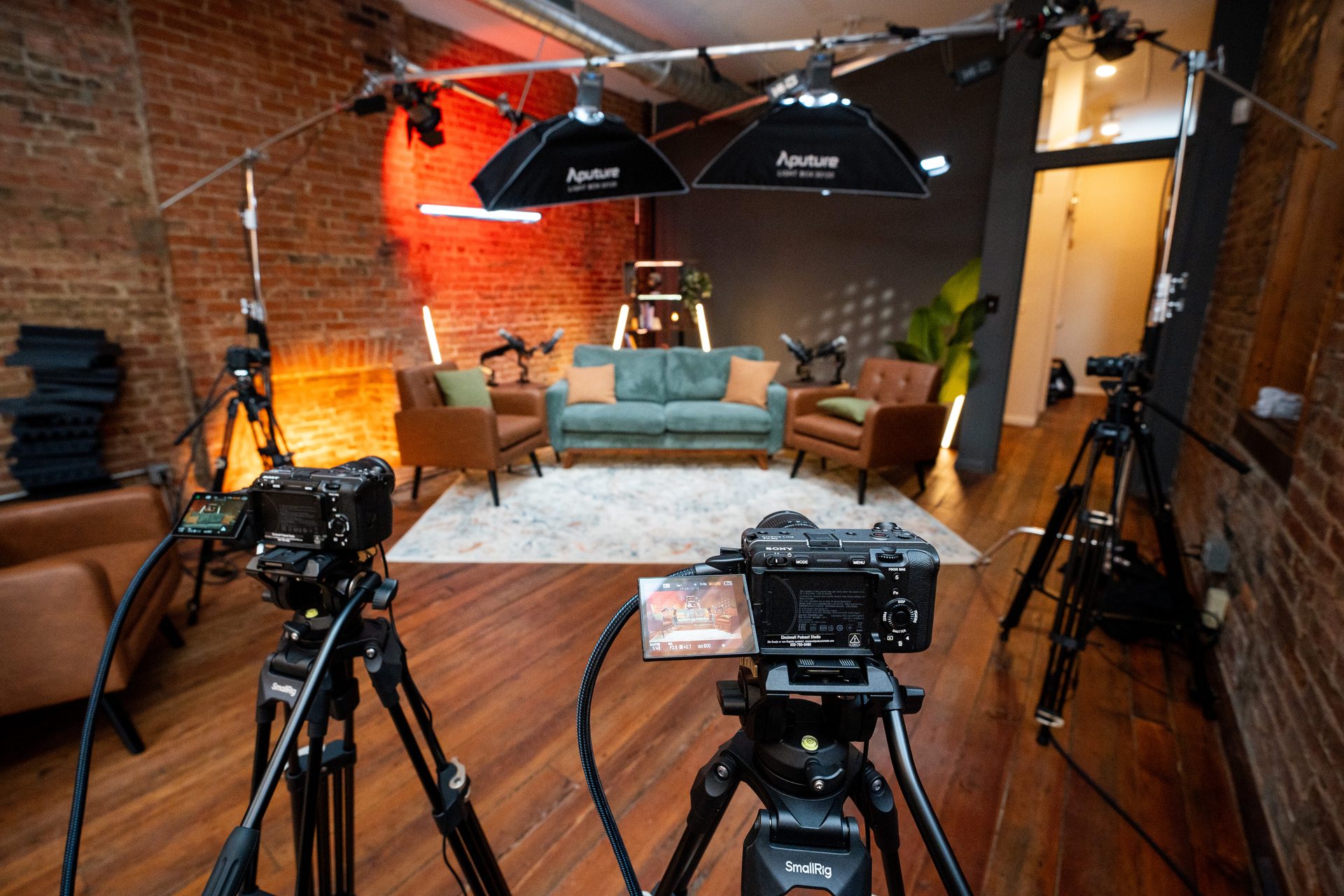
Here's what a single studio session at Cincinnati Podcast Studio typically produces:
- One full-length video podcast episode (30–60 minutes)
- 15–30 short clips for LinkedIn, Instagram, and YouTube Shorts
- One long-form blog post derived from the episode topic
- Two to four email newsletter segments
- A set of quote graphics and audiograms
That's a month or more of content from a two- to four-hour session. Your team shows up, has a conversation, and leaves. We handle the production, editing, and asset delivery. It's the entire premise behind our consulting and content strategy work — build the engine once, then run it on a predictable cadence.
If you're in Greater Cincinnati or Northern Kentucky, this model removes the biggest operational barrier to consistent content: time. You don't need to become a content creator. You need a system that works whether or not your team feels like creating on any given week.
What to Do If You've Tried Content and It Didn't Work
Before writing off content as a strategy, it's worth diagnosing why it didn't work. Most content failures trace to one of three root causes:
Wrong Format
If you tried blogging but your buyers don't read blogs, the format was the problem — not the content. If you ran a podcast but your buyers don't listen to podcasts, same issue. Format selection has to follow audience behavior, not personal preference or what looks popular on marketing Twitter.
Inconsistency Problem vs. Quality Problem
Most teams assume their content failed because it wasn't good enough. In practice, the bigger issue is almost always inconsistency. Audiences need time to find you, subscribe, and build a habit. Quitting at episode four or post number six is quitting before the algorithm or word-of-mouth has a chance to work. If the content was solid and you stopped, the fix is a production model that makes it sustainable — not a total restart from scratch.
No Clear Tie to the Buyer's Decision Process
Content that doesn't connect to a business outcome tends to drift. It becomes educational for its own sake without ever moving a prospect closer to a conversation. Every piece of content should have a clear next step — a Discovery Call link, a podcast episode to listen to, a webinar to register for. Content without a path is just noise.
If you've been through one or more of these patterns, a strategy session with our team is the practical next step. We look at what you've tried, where the gaps are, and what a sustainable production model looks like for your specific audience and sales process. Learn more about our consulting approach.
FAQs: What Content Should My Business Create?
- What type of content works best for B2B companies?
- Video podcasts and long-form thought leadership consistently outperform short-form content alone for B2B. They build the trust and authority your buyers need before making a purchasing decision.
- How often should my business be posting content?
- Consistency matters more than volume. One high-quality video podcast episode per month, repurposed into clips and a blog post, outperforms sporadic daily posts with no strategic thread.
- Should I focus on social media or SEO content?
- Both, but start with a format that generates long-form authority content — a video podcast or webinar series — then use clips and articles to feed social and SEO. Don't build in reverse.
- What if we've tried content before and it didn't work?
- Most content failures come from one of three causes: wrong format, inconsistent output, or no clear tie to the buyer's decision process. A strategy session helps diagnose the real blocker.
- How do we create content without overwhelming our team?
- Batch recording solves this. One 2–4 hour studio session produces a full podcast episode, 15–30 short clips, a blog post, and email content — removing daily production pressure entirely.
- Do we need a professional studio or can we record at home?
- Home setups work for testing a concept. For consistent, professional content that builds trust with buyers at the CEO and executive level, studio production is the difference between credible and DIY.
Ready to Build a Content Strategy That Actually Works?
The businesses winning with content right now aren't posting more — they're posting smarter. They've built a repeatable system anchored in one high-value format, repurposed efficiently, and distributed consistently. That system doesn't have to be complicated. It just has to match how your buyers make decisions.
If you're a B2B team in Cincinnati or Northern Kentucky and you're ready to stop guessing and start building, we'd like to talk. Schedule a Discovery Call with the CPS team and we'll help you map the right content engine for your business, your audience, and your team's actual bandwidth.
Already know you want a podcast? Start with podcast idea research — a structured process for validating your concept before you commit to production. Or if you're ready to explore the full picture, contact our team and we'll take it from there.