
Video Podcasting vs Audio-Only: Why Video Wins for Modern B2B Brands
Video Podcasting vs Audio-Only: Why Video Wins for Modern B2B Brands
Audio podcasts still work. But if your goal is reach, trust, and a repeatable content engine, video podcasting is the more efficient choice—especially for B2B teams that need content to do more than “get downloads.”
You’re not choosing a format. You’re choosing a distribution advantage.
Video podcasting outperforms audio-only because it expands discovery on YouTube and social, increases trust through face-to-face communication, and creates more repurposable assets per recording—without adding much operational complexity when production is handled well.
Quick answer
Video podcasting is better than audio-only when you want faster audience growth, stronger trust, and more content from every episode. Video unlocks discovery on YouTube and social platforms, improves message retention because people can see expressions and visual proof, and turns one recording into clips, webinar segments, sales enablement, and training assets. Audio can still be distributed—but starting with video gives you more leverage.
The real decision: are you building a show, or building a content system?
Most audio-only podcasts are treated like a passion project: publish weekly, hope the audience finds you, and measure success by downloads.
Most successful B2B video podcasts are treated like a system:
One conversation becomes long-form + shorts + sales content + internal assets
Distribution happens where attention already lives (YouTube + LinkedIn-style feeds)
The show builds trust at scale, even when your team isn’t in the room
If you’re a decision-maker, video podcasting is less about “adding cameras” and more about removing friction from marketing.
Ready to see what a video-first setup looks like? Book a tour here: Schedule a Studio Tour
1) Video multiplies discovery
Audio-only discovery is limited. Most people don’t browse podcast apps like they browse YouTube or social feeds. They find shows through word-of-mouth or searching for very specific topics.
Video changes that because it lives in search-and-suggest ecosystems:
YouTube search results
Suggested videos
“Up next” recommendations
Clips shared natively on social platforms
In plain terms: video gives you more entry points into your content, even if your audience never opens a podcast app.
If you want help picking topics that actually get discovered, start with Podcast Idea Research instead of guessing.
2) Video builds trust faster
For B2B, trust is the whole game. Video does something audio can’t: it shows presence.
People can see:
Confidence (or lack of it)
Credibility signals (how you explain, not just what you say)
Chemistry between hosts/guests
Proof elements (screens, demos, visuals, products)
Audio can be intimate—no question. But video shortens the “do I trust these people?” timeline because it feels closer to a real conversation and you can read their facial expressions.
This is why video podcasts often become the top “pre-sales” asset—prospects watch an episode and show up to the sales call already aligned.
If you need help shaping your show into a trust-building asset (not a random interview series), Consulting is the fastest path.
3) Video gives you repurposing leverage (shorts aren’t optional anymore)
One of the biggest B2B mistakes is recording a great conversation… and then posting it once.
Video podcasting fixes that because repurposing is built-in:
Short clips for awareness
Quote cards and captions pulled from transcripts
Topic-based cut-downs (mini-episodes)
Teasers for email and LinkedIn
Sales snippets answering common objections
Audio-only can be repurposed, but it’s more work to make it scroll-stopping because you still need visuals.
If you are wanting to skip the podcast and just make a bunch of short form content for socials. This is exactly what our Short-Form Content package is designed to support.
4) Video improves internal alignment (it’s not just external marketing)
Here’s the underused advantage: video podcasts become internal assets too.
Your episodes can:
Train new hires on positioning and talk tracks
Create consistent messaging across sales + marketing
Capture leadership thinking while it’s fresh
Reduce “one-off” explaining by pointing people to an episode
If your leadership team is already having the conversations, recording them is operationally smart.
And if you’re already doing webinars, video podcasting makes them better. You can record in a podcast format and deploy segments into a webinar strategy. See Webinar Production.
5) Video turns your expertise into durable assets (courses, training, enablement)
B2B teams should think in assets, not posts. Video podcasting creates durable building blocks:
The best episodes become training modules
The recurring topics become course outlines
The Q&A becomes an internal knowledge base
That’s why video podcasting pairs well with product education, client onboarding, and thought leadership.
If you’re building training or a paid/free course library, connect the dots with Course Creation.
When audio-only still makes sense
Audio-only can still be the right move when:
Your audience primarily listens during commutes and won’t watch
Your topics are extremely niche and don’t benefit from visuals
You truly can’t support video production and distribution
But here’s the key: you don’t have to choose one. A video podcast can still be published as audio everywhere. The reverse isn’t true—you can’t magically turn audio into high-performing video.
Common mistakes teams make when switching to video
Mistake 1: Treating video like “audio with cameras.”
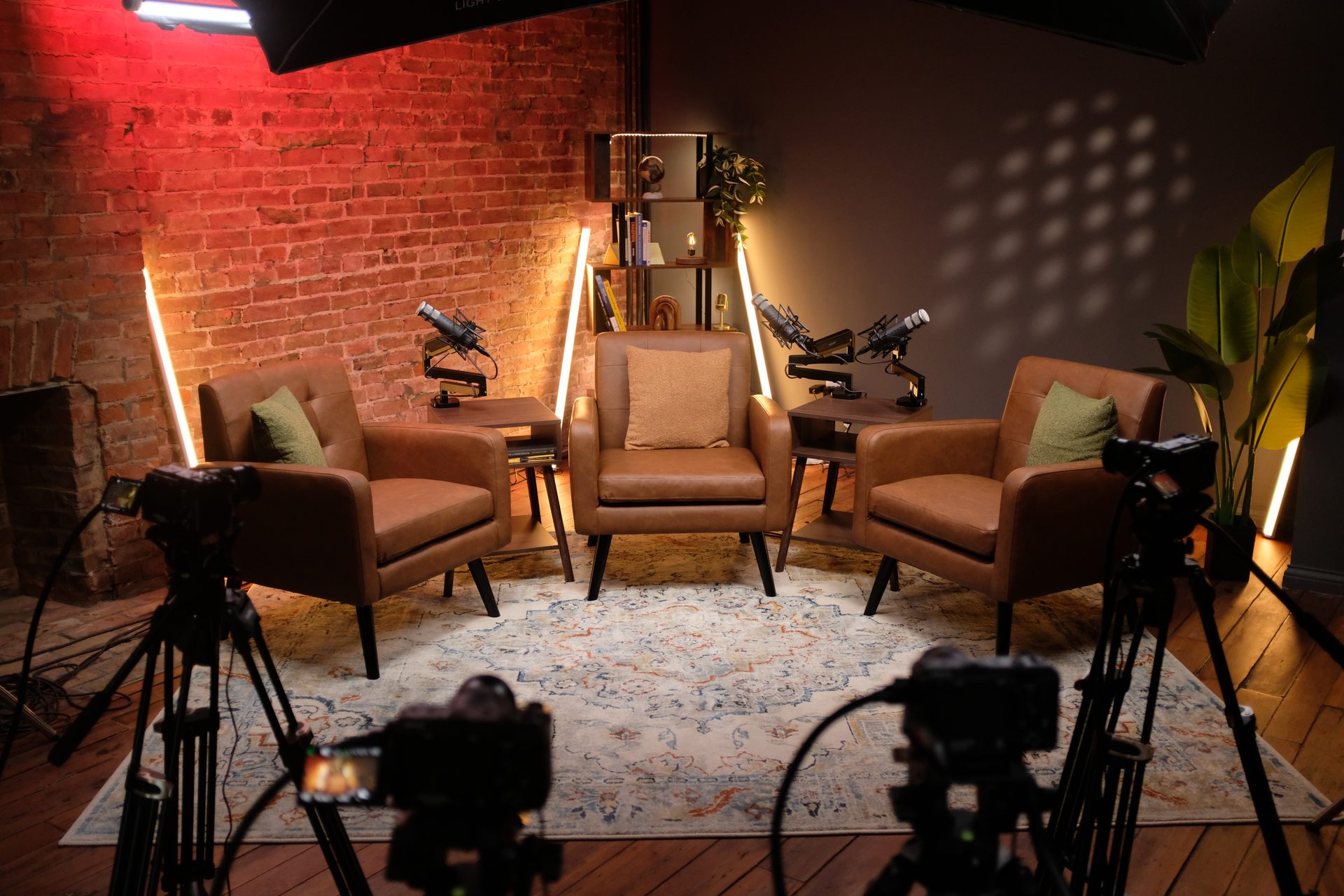
Video needs a stronger visual plan: framing, lighting, and a set that looks credible—not flashy.
Mistake 2: Recording without a clip strategy.
If you don’t define what clips you need, you’ll end up with random highlights instead of a library of usable assets.
Mistake 3: Overcomplicating gear and workflow.
Teams stall out chasing equipment perfection. The winning move is a repeatable process where you show up, talk, and publish consistently.
Mistake 4: No clear “who it’s for” positioning.
If the show isn’t tightly positioned, video just makes the confusion more visible.
If you want a practical playbook, start browsing our Resources.
We're here to help, and we're local.
If you’re a B2B team in Greater Cincinnati or Northern Kentucky, video podcasting is a competitive advantage because it helps you stand out in a relationship-driven market. A professional Cincinnati video podcast studio setup signals credibility fast—and it creates a steady stream of content you can use across local partnerships, recruiting, and sales follow-up.
Want to see what “show up and talk” looks like in practice? Check out the Cincinnati Business Podcast as an example of an authority ecosystem.
FAQs
Is video podcasting harder than audio-only?
Not if the workflow is built correctly. The “hard parts” are production, lighting, camera angles, and post-production—not the conversation. With a studio-first process, you show up, talk, and leave with a full content package (long-form plus clips) without turning it into a second job.
Do I need YouTube for a video podcast to be worth it?
You don’t need YouTube, but it’s one of the biggest reasons video wins because of search and recommendations. Even if your primary channel is LinkedIn or email, YouTube gives your episodes a durable home and increases the odds that the right buyer finds you months later.
Can I publish a video podcast as audio too?
Yes—and that’s the smartest approach for most brands. Record video first, then distribute the audio feed everywhere. You get the full reach of video plus the convenience of audio listeners without duplicating effort.
Conclusion + CTA
Audio-only podcasts can work. But if you want more reach, stronger trust, and a content engine that supports revenue, video podcasting is the better business decision—and you can still distribute audio everywhere.
If you’re ready to see the simplest path to a video-first workflow, Schedule a Studio Tour and check out the Cincinnati Podcast Studio website to see real examples of brands, like yours, doing podcasts.