
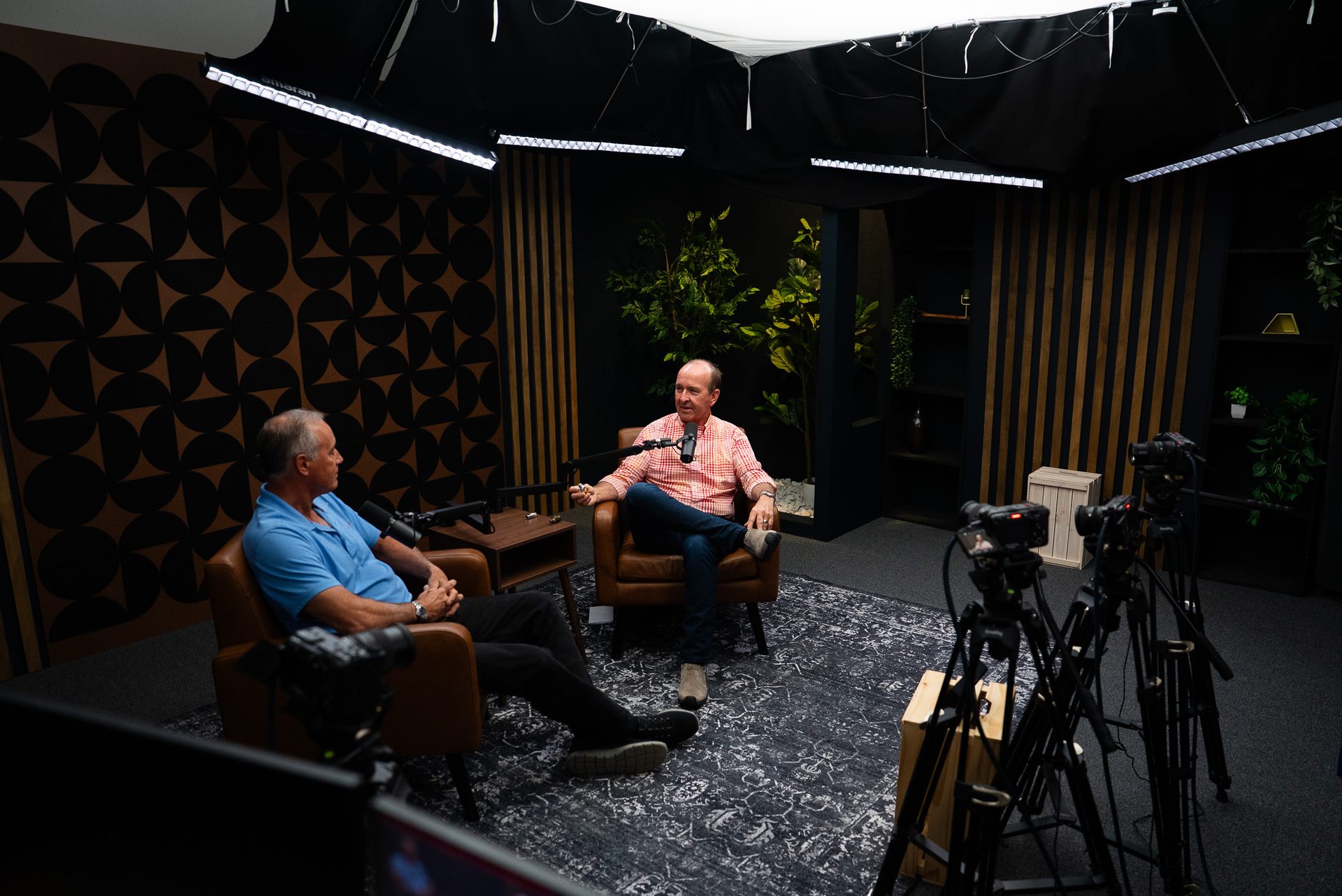
Podcast Interview Format for Business Leaders | CPS
The Best Podcast Interview Format for Business Leaders
Most business leaders who start a podcast spend weeks choosing a name and mic — and about 15 minutes deciding on a format. That's backwards. Format is the operational blueprint behind every episode. Get it wrong and you'll burn time, produce content that's hard to repurpose, and eventually lose momentum. Get it right and every session runs cleanly, guests show up prepared, and you walk out with an episode plus a bank of clips.
This article breaks down the formats that actually work for B2B podcasts, why semi-structured wins almost every time, and how to build the pre-interview prep that sets up great conversations.
Quick Answer: What's the Best Podcast Interview Format?
The best podcast interview format for business leaders is a semi-structured conversation built around 5–7 core questions — not a rigid script. This gives each episode a clear arc while leaving room for authentic exchanges that build trust and generate shareable moments. Most business podcast interviews run 30–45 minutes and are structured to produce both a long-form anchor episode and a bank of short-form video clips.
Why Format Matters More Than Most Podcasters Think
Format isn't just about how your episode sounds. It determines whether you can produce consistently at scale, whether your team can prep efficiently before each session, and whether the content you create is actually editable into clips that perform on LinkedIn and Instagram.
A loose format that relies on improvisation might work for personality-driven shows, but for a professional video podcast built to generate authority and pipeline, consistency is the whole game. Listeners should know what to expect. Guests should know how to prepare. And your production team should be able to run each session from a repeatable playbook.
The format also signals credibility. A host who moves through a conversation with structure and confidence reads as an expert — even before the content lands. Format shapes perception before a word is said.
The Most Common Business Podcast Interview Formats
There are four formats you'll see across business podcasts. Each has a real use case — and real tradeoffs.
Fully Scripted Q&A
The host reads prepared questions verbatim. The guest knows every question in advance and comes with polished answers. This produces tight, well-paced content and is popular in PR-driven interview contexts. The problem: it sounds exactly like what it is — a scripted exchange. Guests perform instead of think. The best moments happen in unscripted beats, and a fully scripted format kills those off before they can happen.
Free-Form Conversation
No prep, no structure, just two people talking. This format can produce genuinely compelling content when the chemistry is right and both parties are skilled communicators. The problem: it's inconsistent by design. Episodes run long or go sideways. Editing takes twice as long. And guests who aren't experienced on camera need a structure to lean on — without one, they get nervous and the quality drops.
Semi-Structured Interview
The host prepares 5–7 anchor questions built around a clear theme. The guest receives context on the topics in advance but not the exact questions. The conversation follows the arc, but the host digs deeper when something earns it. This is the format that produces the most usable content — both long-form and clip-ready.
Panel Format
Three or more participants discuss a topic. Works well for roundtables, industry debates, or co-hosted shows. The logistics are more complex — coordinating multiple guests, managing speaking time, keeping the conversation from fragmenting — but when it's well-produced, it signals serious authority. Our Cincinnati Business Podcast has featured panel-style conversations with multiple local business leaders in this format.
Why Semi-Structured Wins for B2B Podcasting
The semi-structured format is the dominant choice for business podcasts for a reason: it produces consistent, scalable output without sacrificing the authentic exchanges that actually build trust.
Here's the practical case:
- 5–7 anchor questions give each episode a narrative arc. You know where the conversation is going. Your editor knows how to structure the cut. Your guest knows how to prepare without over-preparing.
- It creates natural clip moments. When a guest lands a quotable insight or tells a real story, it's usually in response to a well-structured question — not in a free-form tangent. Those are the moments that become your best short-form clips.
- Hosts can go deeper when something earns it. If a guest says something unexpected and interesting, you can follow it. The structure is a frame, not a cage.
- Guests feel prepared, not interrogated. A brief sent in advance with your 3 core themes lets them show up as a thoughtful contributor rather than someone trying to keep up.
If you're thinking through format as part of a broader content strategy, podcast idea research is a useful starting point — it helps you define your audience and what they actually want to hear before you commit to a format.
Episode Length for Business Audiences
Episode length is a format decision, not an afterthought. Commit to a target length before you record — it shapes how you pace questions, when you push for depth versus moving on, and how much raw footage your team has to work with.
For B2B podcasts, the standard guidance holds: 30–45 minutes is the sweet spot. Here's the logic:
- Under 20 minutes: Too short to build the kind of trust that drives action. You can surface an insight, but you can't establish real credibility or take a conversation anywhere meaningful.
- 30–45 minutes: Long enough to go deep on 2–3 ideas, short enough that a busy executive actually finishes the episode. This is also the range that produces the highest clip-to-minute ratio — most episodes yield 8–12 usable short clips in this window.
- 45–60 minutes: Works for complex topics with high-credibility guests. Plan your structure carefully or the conversation will meander in the back half.
- 60+ minutes: Usually better served by recording long and editing to 45. Recording 75 minutes and keeping 45 often produces a better final product than trying to manufacture 45 minutes of content in real time.
If you're in the Cincinnati/NKY market and building a podcast to establish authority with local business leaders and decision-makers, we've found 35–40 minutes to be the format that performs best across both listener completion rates and clip performance.
How to Structure Your Pre-Interview Prep
The quality of a podcast interview is usually determined before the recording starts. Pre-interview prep is where the format either holds up or collapses.
Here's the prep framework we use at Cincinnati Podcast Studio:
1. Send a one-page guest brief
Before the session, send your guest a short document (one page, maximum) that covers: the 3 themes you'll discuss, what listeners care about, and how the episode fits into your show's mission. Don't send the exact questions — you want them prepared, not rehearsed. If they rehearse, the conversation will sound like it.
2. Review the guest's work
Spend 20–30 minutes before each session reviewing your guest's recent LinkedIn activity, published content, and current work. One specific reference — "I read your post on X last week" — unlocks a conversation in a way that generic introductions never do.
3. Start with a warm-up off-record
Before you hit record, spend 3–5 minutes in casual conversation. Ask about their commute, a recent project, whatever breaks the formal energy. Guests who are relaxed when recording starts sound completely different from guests who are still settling in when you ask your first question.
4. Flag your top clip candidates before you record
Review your question list and mark 2–3 questions that are likely to produce the best standalone moments. These are usually the questions that ask for a story, a specific example, or a counterintuitive take. Flag them in advance so you know to let them breathe during the interview instead of moving on too quickly.
The podcast resources section on our site covers more of this kind of prep guidance if you're building your system from scratch.
Common Format Mistakes Business Podcasters Make
Most format problems compound over time. They're easy to ignore in episode three and hard to fix by episode thirty.
Reading from a script. The fastest way to lose a listener is to sound like you're reading. A script creates a flat delivery, kills natural follow-up, and makes guests nervous. Write question notes, not scripts.
No defined intro hook. Listeners decide in the first 60–90 seconds whether they're staying. A weak intro — "Hi, welcome back to the show, today I have a very special guest" — is a format problem, not a writing problem. Build a hook into your format: lead with the one insight the guest is going to share that makes this episode worth finishing.
Ignoring production format when planning content format. A 60-minute free-form conversation is a nightmare to edit. A 40-minute semi-structured interview with a defined arc takes half the time to cut. If you want content that moves through post-production efficiently, your format has to support it from the start. Our video podcast production process is built around formats that produce clean, editable content.
Treating every episode as a one-off. The hosts who build real authority are the ones who treat their podcast as a content system. Each episode follows the same format, feeds into the same content engine, and reinforces the same brand positioning. If you're building toward a podcast and content strategy, format consistency is the operational foundation that makes the system work.
If you're in Greater Cincinnati or Northern Kentucky and thinking through the right format for your podcast, a Discovery Call is a good starting point. We help you define the format before you record episode one — not after you've already produced 20 episodes in the wrong direction.
Frequently Asked Questions
How long should a business podcast interview be?
30–45 minutes is the sweet spot for most B2B audiences. Long enough to build real credibility and depth, short enough that busy decision-makers actually finish the episode. If you record 60 minutes, editing to 40–45 is common and often improves the final product.
Should I send questions to guests in advance?
Yes, but send themes, not a verbatim question list. Share the 3 topics you'll cover so the guest can prepare their thinking — but keep the actual questions flexible so the conversation stays natural and unscripted.
What's the difference between a structured and semi-structured podcast interview?
A structured interview follows a fixed script, question by question, with little room to deviate. A semi-structured interview has a prepared set of 5–7 anchor questions but allows the conversation to go deeper when something valuable surfaces. Semi-structured almost always produces better content.
How many questions should I prepare for a 45-minute podcast episode?
Prepare 6–9 questions but plan to use 5–7. The extras give you a safety net if a topic wraps quickly. Prioritize depth over breadth — two great follow-up exchanges beat five shallow answers.
Can I use the same podcast format for every episode?
Yes — and you should. Consistency in format is what makes batch production possible and what trains your audience to know what to expect. You can vary the theme or guest type without changing the underlying structure.
How do I make a podcast interview feel natural and not scripted?
Warm up off-record first. Review the guest's work before the session so you can reference specifics. Listen actively during recording instead of reading from a list. The most natural-sounding interviews come from a host who's genuinely curious, not one who's checking boxes.
Related Resources from Cincinnati Podcast Studio
- Video Podcast Production — full-service podcast production, 4K video, professional audio, and post-production support
- Short-Form Video Clips — turn your podcast episodes into 10–20 clips per session
- Podcast Idea Research — validate your concept before you invest in production
- Podcast and Content Strategy — build the format, audience, and distribution plan before episode one
- Cincinnati Business Podcast — see the format in action with real local business leaders
- Podcast Resources — guides, prep frameworks, and production tools
- About Cincinnati Podcast Studio
Ready to Build a Podcast That Actually Works?
Format is where the work starts, but production is where it comes together. At Cincinnati Podcast Studio, we help B2B leaders build podcasts that are designed from the start to produce authority content at scale — right format, right production setup, right content engine.
If you're in Cincinnati or Northern Kentucky and want to build a podcast that doesn't just exist but actually works, schedule a Discovery Call. We'll walk through your format, your audience, and exactly what a production system looks like for your business.
Not ready to schedule yet? Contact us and we'll send you the right resources to get started.