DIY Podcast Studio vs Rented Studio: What's Worth It
DIY Podcast Studio vs Rented Studio: Which Option Actually Moves Your Business Forward?
The idea of building your own podcast studio has real appeal. You control the space, the schedule, and the setup. But once you start pricing out what "professional quality" actually requires — cameras, lighting, acoustic treatment, audio interfaces, software — the math shifts fast.
For most B2B businesses trying to publish consistent video content, the real question isn't whether you can build a home studio. It's whether you should.
Summary: Renting a professional studio almost always beats building one for businesses focused on video quality, consistent output, and time efficiency — especially when batch recording is part the plan.
Quick Answer
Building a DIY podcast studio sounds like the frugal move, but once you factor in cameras, audio interfaces, acoustic treatment, lighting, and the hours spent troubleshooting gear, the math rarely works in your favor. For most Cincinnati businesses recording video content, renting a professional studio delivers broadcast-quality results without the upfront investment, ongoing maintenance, or technical headaches — and gets you publishing faster.
What a DIY Podcast Studio Actually Costs
Let's break this down by what you actually need to produce content that looks and sounds professional enough to represent your business well.
Audio-only setup (entry level): A quality USB or XLR microphone, a basic audio interface, headphones, and minimal acoustic panels — you're looking at $500 to $1,500 to get started. That's workable if audio-only is your format and you're not chasing video quality.
Video-capable setup: Now add a 4K camera (or two, if you have guests), proper studio lighting with softboxes or LED panels, a capture card, and an acoustically treated room. You're realistically at $3,000 to $8,000 before you've touched editing software or a teleprompter.
Acoustic treatment is non-negotiable. This is what most first-time studio builders underestimate. A bedroom or spare office room — even with a nice microphone — will pick up HVAC hum, echo, and street noise. Proper acoustic panels, bass traps, and floor treatment can add another $500 to $2,000 to the budget.
And none of this counts the time you'll spend learning how to use it all. For business leaders whose time is the most valuable asset they have, that learning curve has a real cost.
What You Get When You Rent a Professional Studio
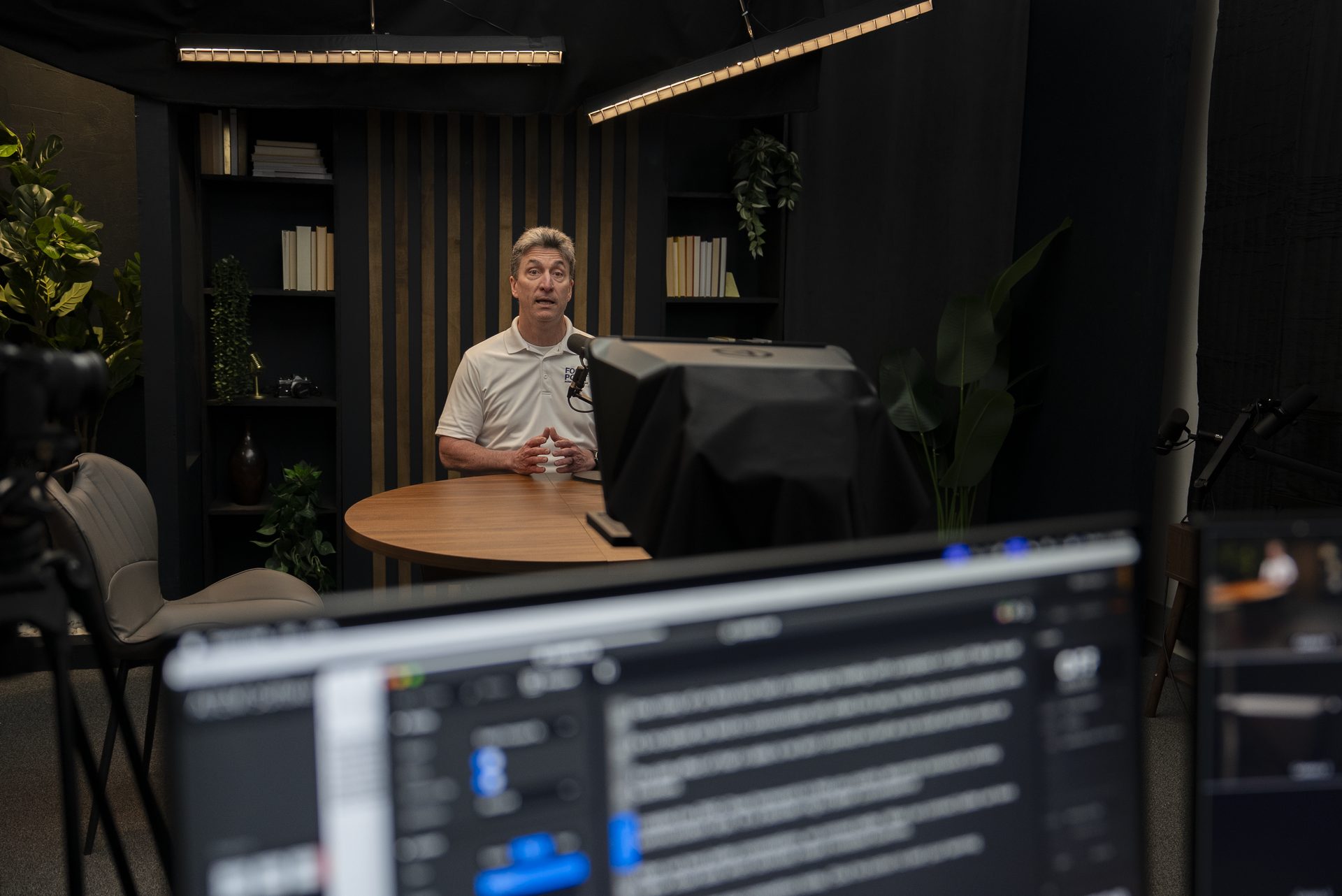
When you book time at a professional podcast studio in Cincinnati, you're not just renting a room. You're renting a complete production environment that's already been designed, calibrated, and tested for exactly what you're trying to do.
At Cincinnati Podcast Studio, that includes:
- 4K multi-camera video — so you walk out with broadcast-quality footage for your podcast, YouTube channel, and short-form clips
- Broadcast-grade audio — treated rooms, professional microphones, and monitoring that catches problems before you finish the session
- Professional lighting and set design — the kind that makes your interview look like a major media production, not a home office recording
- On-site production support — a team handling camera switching, audio levels, and technical issues so you stay focused on the conversation
- No equipment ownership or maintenance — when the technology upgrades, you don't pay for it
The result is content that looks like you invested significantly in production infrastructure — because the studio did, and you're accessing it at a fraction of that cost.
The Hidden Costs DIY Builders Don't See Coming
The upfront gear cost is what catches people's attention. The ongoing costs are what erode the case for DIY over time.
Setup and breakdown time. Every session in a home studio means configuring the space — moving furniture, setting up lights, checking audio levels, troubleshooting whatever decided not to work this week. If you're recording once a month, that overhead is manageable. If you're running a serious content engine with weekly episodes, that time compounds.
Technical troubleshooting. Gear fails. Software updates break workflows. A USB driver conflict right before you start recording a guest interview is a real scenario that happens in home setups. Each troubleshooting session is time you're not running your business.
The quality ceiling. Home acoustics have hard limits. You can add panels and rugs and curtains, but a spare bedroom is not a treated recording environment. Most home setups hit a quality ceiling that a professional space clears easily — and that gap shows up on video more than anywhere else.
Equipment aging. Technology evolves. The camera that was cutting-edge two years ago may not match current production expectations. When you own the gear, upgrades come out of your pocket. When you rent, the studio handles it.
When DIY Makes Sense (and When It Doesn't)
There are legitimate use cases for a DIY setup. Here's the framework for thinking it through clearly.
DIY makes sense when:
- You're producing high-frequency solo audio content (daily or multiple times per week) where showing up consistently matters more than production value
- You have a genuine technical background and enjoy managing gear
- You're in an early-stage business where cost constraints are real and video quality is secondary
- You already have a dedicated, acoustically quiet space that won't require major treatment
Renting makes more sense when:
- Your content includes video — LinkedIn clips, YouTube, course recordings, or webinars where how you look matters as much as what you say
- You're interviewing guests and want a professional environment that reflects well on both parties
- You're batch recording — multiple episodes or pieces of content in a single session
- Your audience is professional decision-makers who will judge production quality as a signal of credibility
- Your time is better spent running your business than troubleshooting gear
For most B2B businesses in the Greater Cincinnati area using content to build authority and pipeline, the answer points clearly toward studio rental options at CPS — not because DIY is impossible, but because the ROI calculation almost always favors it.
How Cincinnati Businesses Use Studio Rentals to Scale Content
The businesses getting the most value from studio time aren't treating it like a one-off production. They're running what we call a content engine: a repeatable system that turns a small number of recording sessions into a large volume of publishable content.
Here's the model in practice:
Batch recording. Instead of booking a studio once a month for one episode, you book a half-day or full day and record four to six episodes back-to-back. The per-episode cost drops significantly. Your calendar stays protected the rest of the month.
Multi-format output from a single session. The same recording session produces your podcast episode, a YouTube upload, short-form video clips for LinkedIn and Instagram, and source material for blog posts and email newsletters. One session, 20 to 40 pieces of content.
Production support keeps you in your lane. When a production team is running the technical side, you stay focused on the conversation — which is where the actual value lives. No checking camera angles mid-interview, no second-guessing audio levels, no pulling yourself out of the moment to troubleshoot something.
If you're a B2B team in Cincinnati or Northern Kentucky building a content strategy around thought leadership and trust, this model is worth a serious look. The investment in studio time is offset by the content volume you walk out with — and the professional quality that makes it worth sharing.
We also offer webinar recording services, course creation studio time, and content strategy and consulting for businesses that want a broader content plan, not just a recording session.
Frequently Asked Questions
How much does it cost to build a basic podcast studio at home?
A basic audio-only home setup runs $500 to $1,500 for a decent microphone, interface, and minimal acoustic treatment. A video-capable setup with 4K cameras, proper lighting, and acoustic panels typically runs $3,000 to $8,000 or more — not including your time to learn and maintain it.
Is it better to build a home studio or rent one?
It depends on your output goals. If you're publishing video content consistently and want broadcast quality, renting a professional studio gives you better results per dollar and per hour. DIY makes more sense for high-frequency solo audio content where consistency matters more than production value.
What equipment do I need for a professional-looking podcast?
At minimum: a 4K camera, proper studio lighting, an audio interface, broadcast-quality microphone, and an acoustically treated space. That list adds up quickly. A rented studio includes all of it — plus someone who already knows how to run it.
Can I record multiple episodes in one studio rental session?
Yes. Batch recording is one of the biggest advantages of renting. Many Cincinnati businesses record four to six episodes in a single session, which dramatically reduces the per-episode cost and keeps a consistent production schedule without blocking calendar time every week.
What are the hidden costs of a DIY podcast studio?
The ones that hit hardest: acoustic treatment (which most home setups underestimate), the time spent troubleshooting gear problems, the learning curve on software like audio DAWs and video editing, and the ongoing maintenance and upgrades as technology evolves.
Does renting a podcast studio include production support?
At Cincinnati Podcast Studio, yes. Our sessions include a production team that handles camera framing, audio levels, switching, and the technical side — so you focus on the conversation, not the gear.
Related Reading
- Video podcast production at Cincinnati Podcast Studio
- Podcast idea research — before you commit to a format
- Cincinnati Business Podcast — see what studio-produced content looks like
- Resources hub — tools and guides for business content creators
Ready to Skip the Gear Headache?
If you've been on the fence about building vs. renting, the fastest way to settle it is to see what a professional session actually produces. Book a Discovery Call and we'll walk through your content goals, your format options, and whether studio time makes sense for where you are right now.
Or if you're still in the planning stage, our consulting team can help you map out a content strategy before you commit to any production model. Contact us and let's talk through it.